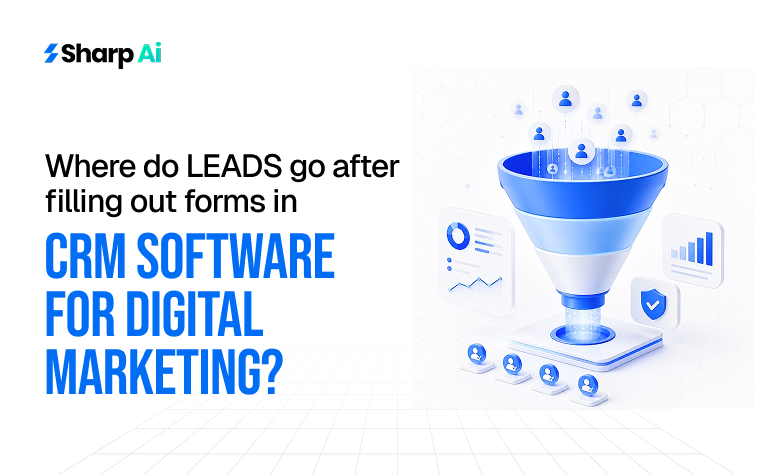
Why Lead Management After Form Submission Determines Conversion Rates
Lead management after form submission plays a major role in conversion rates because it determines how quickly a prospect is contacted, how accurately they are qualified, and how effectively they are nurtured. A form submission only shows initial interest. The actions taken immediately after that decide whether the lead moves forward or disappears. Using CRM Software for Digital Marketing helps businesses manage this process with faster responses, better tracking, and automated follow-ups.
Why Post-Submission Lead Management Impacts Conversions
Faster Response Creates Higher Conversion Opportunities
- Instant Lead Response: The first few minutes after a form submission are critical. Businesses that respond quickly have a much higher chance of qualifying the lead compared to those that wait hours or days.
- First Response Advantage: Many prospects engage with the first company that provides a helpful response. Delayed follow-ups give competitors the opportunity to win the customer.
- Preventing Interest Drop-Off: A prospect’s buying intent decreases over time. Automated replies, notifications, and follow-up workflows help keep conversations active from the start.
Accurate Qualification and Lead Routing Prevent Lost Opportunities
- Automatic Lead Sorting: A strong CRM system can capture form details, identify lead quality, and route enquiries to the right sales team member without manual effort. This is one of the key CRM benefits for marketing teams.
- Better Sales Handoffs: When marketing and sales teams share the same system, leads move smoothly through the process instead of getting stuck between departments.
- Prioritising High-Value Leads: Lead scoring helps teams focus their attention on prospects who are more likely to convert, improving overall sales efficiency.
Personalised Follow-Ups Improve Lead Engagement
- Relevant Communication: Form submissions provide valuable information about a prospect’s needs. Businesses can use this data to send personalised messages instead of generic responses.
- Multi-Channel Nurturing: Email, SMS, calls, and automated reminders help maintain engagement throughout longer buying journeys.
- Consistent Follow-Up: Automated workflows ensure no enquiry is forgotten, even when teams are busy managing multiple campaigns.
Complete Visibility Improves Marketing Decisions
- Track Every Interaction: A CRM shows the complete lead journey, from the first form submission to conversations, appointments, proposals, and final outcomes.
- Identify Conversion Gaps: Reporting reveals where leads drop off, helping businesses improve their campaigns, sales process, and customer experience.
- Measure Real Campaign Performance: Instead of only tracking form fills or clicks, businesses can understand which campaigns generate actual revenue.
How CRM Software Processes New Leads Automatically
CRM software processes new leads automatically by capturing prospect information, organising lead data, scoring interest levels, and triggering follow-up actions without requiring manual tracking. For digital marketing teams, CRM Software for Digital Marketing creates a connected workflow where every new enquiry is captured, assigned, and moved through the sales process efficiently.
How CRM Software Automatically Processes New Leads
Automatic Lead Capture and Contact Creation
- Captures Leads From Multiple Sources: A CRM collects new enquiries from website forms, social media campaigns, landing pages, ads, and appointment bookings as soon as a prospect shares their details.
- Creates Contact Profiles Instantly: Instead of manually adding information, the system automatically creates a lead record with details such as name, email, phone number, company information, and where the enquiry came from.
- Enriches Lead Data: Some CRM platforms connect with external data sources to add useful details, such as company size, industry, location, or online presence, helping teams understand prospects better.
Automatic Lead Scoring and Qualification
- Tracks Prospect Behaviour: CRM systems monitor actions such as website visits, content downloads, email engagement, and previous interactions to understand buying intent.
- Ranks Lead Quality: The platform assigns scores based on engagement and customer fit, helping sales teams identify which prospects need immediate attention.
- Organises Leads Into Segments: New enquiries can be automatically grouped by industry, interest, campaign source, or buying stage, making follow-ups more relevant.
Smart Lead Assignment and Follow-Up
- Routes Leads to the Right Person: CRM workflows automatically assign enquiries to the correct team member based on rules such as location, service type, availability, or expertise.
- Sends Instant Notifications: Sales representatives receive alerts when a high-value lead enters the system, allowing them to respond quickly.
- Automates Lead Nurturing: Prospects who are not ready to buy immediately can enter automated email, SMS, or chatbot sequences until they show stronger buying intent.
Better Pipeline Visibility and Conversion Tracking
- Moves Leads Through Sales Stages: A CRM automatically tracks progress from new enquiry to contacted, qualified, proposal sent, won, or lost.
- Reduces Missed Opportunities: Automated reminders and task management ensure leads do not get forgotten during busy periods.
- Measures Marketing Performance: Reporting shows which campaigns generate valuable leads and where prospects drop out of the journey.
What to Look for in a CRM’s Lead Routing and Assignment Capabilities
As a CRM buyer evaluating Sharp AI, focus on how well its lead routing and assignment workflows match your sales process. The key areas to review are automated lead distribution, conditional assignment rules, source tracking, and instant team notifications. Unlike some CRMs with dedicated routing engines, Sharp AI uses its workflow builder to create custom lead assignment systems, meaning the results depend on how effectively the rules are configured.
Lead Distribution and Assignment Options
Round-Robin Lead Assignment
A strong CRM should allow leads to be distributed evenly across team members. In Sharp AI, check whether the Assign to User workflow action can rotate new leads between selected users so every sales representative receives a fair share of enquiries.
Weighted Lead Routing
For teams with different experience levels, evaluate whether the system supports weighted assignment. This allows businesses to send more leads to senior sales representatives or top performers while maintaining a structured distribution process.
Conditional Lead Assignment
The CRM should support routing rules based on lead information. Look for the ability to assign contacts based on:
- Form responses
- Custom fields
- Lead source
- Location
- Campaign tracking details
- Service interest
This ensures enquiries reach the most suitable team member instead of being manually reassigned.
Lead Source Tracking and Workflow Triggers
Source-Based Routing
A capable CRM Software for Digital Marketing setup should identify where each lead comes from and trigger the correct workflow. For example:
- Facebook Lead Form submissions
- Website enquiries
- Landing page conversions
- Incoming calls
- SMS conversations
This helps businesses create different follow-up processes for different lead sources.
New Lead and Ownership Rules
Check whether the CRM can identify unassigned contacts and automatically route them without changing ownership of existing leads. This prevents duplicate work and ensures clear responsibility.
Tag-Based Assignment Logic
Look for flexible automation where tags, pipeline stages, or customer actions can trigger reassignment. For example, a lead requesting a specific service can automatically move to the relevant sales specialist.
Follow-Up and Team Accountability Features
Instant Team Notifications
Fast response times directly impact conversions. The CRM should notify assigned team members immediately through email, SMS, mobile alerts, or internal notifications when a new lead arrives.
Call and Conversation Ownership
Evaluate whether incoming calls, SMS messages, and inbox conversations remain connected to the correct assigned user. This creates accountability and prevents leads from being lost between team members.
Pipeline Visibility and Lead Tracking
A good CRM should show the full journey of every enquiry, including:
- New lead
- Contacted
- Qualified
- Proposal sent
- Follow-up required
- Won or lost
This allows managers to identify delays and improve conversion rates.
How CRM Automation Prevents Missed Sales Opportunities
Sharp AI CRM automation prevents missed sales opportunities by removing delays, improving follow-ups, and keeping every lead active throughout the sales journey. Instead of relying on manual replies or memory, automation ensures that enquiries are captured, contacted, nurtured, and tracked until they convert.
A well-configured CRM Software for Digital Marketing system helps agencies reduce lead leakage by handling three major areas: instant engagement, consistent follow-up, and pipeline management.
How Sharp AI CRM Automation Stops Missed Sales Opportunities
Instant Response Through Missed Call Text-Back
Missed calls often mean lost revenue because prospects may contact a competitor after receiving no response. Sharp AI automation can send an immediate text message when a call is missed, acknowledging the enquiry and creating an opportunity for follow-up.
This helps businesses maintain fast response times even when team members are unavailable.
Automated Multi-Channel Lead Follow-Up
New enquiries need timely communication to maintain interest. Sharp AI workflows can automatically trigger:
- SMS responses after form submissions
- Email follow-ups
- Appointment booking links
- Reminder messages
- Lead nurturing sequences
This ensures prospects receive consistent communication instead of waiting for manual outreach.
Pipeline Monitoring and Stale Lead Recovery
Leads often get lost when opportunities remain untouched in sales pipelines. Sharp AI automation can monitor inactive deals and trigger actions when a lead has not moved forward.
For example:
- Notify sales representatives about neglected opportunities
- Create follow-up tasks
- Send re-engagement messages
- Move leads into specific nurture campaigns
This prevents valuable prospects from becoming forgotten contacts.
Key Sharp AI Automation Features That Reduce Lead Leakage
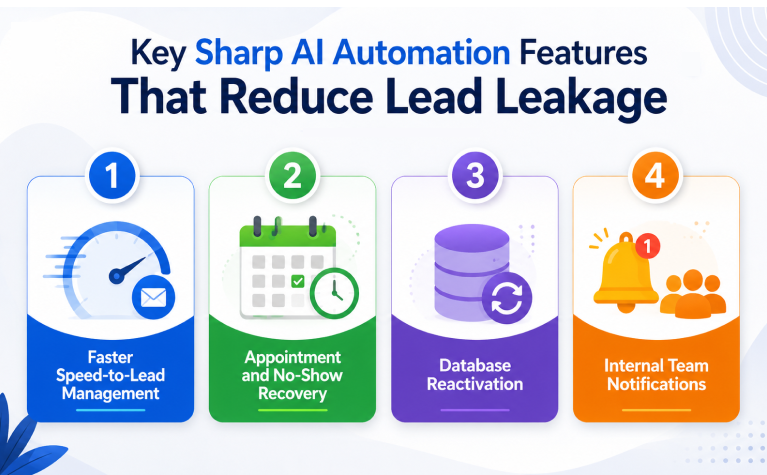
Faster Speed-to-Lead Management
Quick responses improve the chances of converting new enquiries. Automated workflows allow businesses to respond instantly, helping them compete with companies that rely on slower manual processes.
Appointment and No-Show Recovery
Missed meetings do not have to become lost opportunities. Automated confirmations, reminders, and rebooking links help reduce no-shows and encourage prospects to continue the conversation.
Database Reactivation
Not every lead converts immediately. Sharp AI automation can identify older contacts and run targeted SMS or email campaigns to reconnect with previous prospects who showed interest but stopped responding.
Internal Team Notifications
Automation keeps sales teams accountable by sending alerts when:
- A new high-value lead arrives
- A prospect replies
- A deal remains inactive
- A follow-up task is overdue
This ensures opportunities are handled by the right person at the right time.
Why Complete Lead Visibility Matters for Marketing Agencies
Complete lead visibility is essential for marketing agencies because it shows the full journey of every prospect, from the first interaction to the final conversion. Without clear tracking, agencies struggle to prove campaign performance, identify what drives revenue, and make informed marketing decisions. A CRM Software for Digital Marketing solution connects lead data, campaigns, and sales outcomes in one place.
Why Lead Visibility Matters for Marketing Agencies
Proves Marketing ROI With Real Revenue Data
- Connects Campaigns to Conversions: A CRM helps agencies see which ads, keywords, channels, and campaigns generate actual customers, not just clicks or enquiries.
- Shows True Campaign Performance: Instead of reporting only impressions or traffic, agencies can demonstrate how marketing activity contributes to revenue growth.
- Builds Client Trust: Clear reporting helps clients understand the value of their investment and reduces uncertainty about campaign results.
Improves Client Retention and Agency Growth
- Reduces Client Churn: When clients can clearly see lead quality, sales progress, and revenue impact, they are more likely to continue working with the agency.
- Creates Better Communication: Shared visibility between marketing and sales teams removes confusion around lead quality and campaign outcomes.
- Strengthens Agency Relationships: Transparent reporting positions agencies as growth partners rather than just service providers.
Enables Smarter Campaign Optimisation
- Identifies High-Performing Channels: Agencies can discover which campaigns, keywords, and platforms attract the most valuable prospects.
- Reduces Wasted Marketing Spend: Instead of focusing only on lead volume, teams can optimise budgets based on conversion rates and customer value.
- Improves Targeting Decisions: Lead quality insights help agencies adjust messaging, audiences, and strategies to attract better-fit customers.
Creates a Single Source of Truth
- Connects Data Across Platforms: A CRM combines information from websites, ads, emails, calls, and sales conversations into one central system.
- Tracks the Complete Lead Journey: Teams can see where leads enter, how they move through the pipeline, and where conversions are lost.
- Improves Decision-Making: Real-time dashboards replace guesswork with accurate data for campaign planning and growth strategies.
Common CRM Workflow Gaps That Cost Agencies Clients
CRM workflow gaps can quietly cost agencies clients by creating delays, poor communication, and inconsistent customer experiences. Even when an agency generates strong leads, weak automation and disconnected processes can cause prospects to lose interest, clients to feel ignored, and revenue opportunities to disappear. A well-structured CRM Software for Digital Marketing system helps agencies close these gaps by connecting lead management, sales processes, and client relationships.
Common CRM Workflow Gaps That Hurt Agency Growth
Slow Lead Response and Poor Handoff Processes
- Delayed Lead Follow-Up: New enquiries can sit without action when automated routing rules are missing. Slow responses reduce the chance of converting interested prospects into customers.
- Lost Lead Context: When leads move between marketing, sales, and account teams, important information such as previous conversations, requirements, and agreements can get lost.
- Manual Data Entry: Teams waste valuable time copying information from forms, emails, and messages instead of focusing on conversations that drive revenue.
A CRM for digital marketing agency teams helps solve these issues by keeping lead information centralised and ensuring every team member has access to the right customer details.
Inefficient Sales Pipeline Management
- No Clear Pipeline Visibility: Without defined stages, agencies struggle to understand whether leads are new, contacted, qualified, in proposal stages, or ready to close.
- Missed Follow-Up Opportunities: Without automated reminders and task management, potential clients may be forgotten after initial conversations.
- Slow Proposal Processes: Manual quote creation and approval steps delay decision-making and create unnecessary friction for prospects.
Using one of the Best CRM Marketing Platforms allows agencies to automate repetitive tasks and keep opportunities moving through the pipeline.
Broken Client Onboarding and Retention Workflows
- No Automated Onboarding Journey: After a contract is signed, clients may not receive clear next steps, welcome messages, or progress updates. This creates a poor first impression.
- Missing Client Health Signals: Without tracking engagement, communication patterns, and account activity, agencies may miss early signs that a client is becoming unhappy.
- Disconnected Client Data: When sales, support, and account management teams use separate systems, important client information becomes fragmented.
Limited Reporting and Client Visibility
- Incomplete Performance Tracking: Agencies may track activity but fail to connect campaigns, conversations, and client outcomes together.
- Difficulty Proving Value: Without clear reporting, clients may question results because they cannot see how marketing efforts contribute to business growth.
- Decision-Making Based on Guesswork: Teams lack the insights needed to improve workflows, optimise campaigns, and increase retention.
Key CRM Features That Improve Lead Management and Conversion
Sharp AI CRM improves lead management and conversion by combining automated workflows, lead tracking, communication tools, and conversion-focused features into one platform. Instead of managing leads across separate systems, agencies can capture enquiries, organise opportunities, follow up automatically, and track every step of the customer journey through a connected CRM Software for Digital Marketing system.
Key Sharp AI CRM Features That Improve Lead Management and Conversion
Visual Sales Pipelines for Better Lead Tracking
- Custom Pipeline Stages: Sharp AI allows agencies to create visual pipelines that match their sales process, such as New Lead, Contacted, Qualified, Proposal Sent, Follow-Up, Won, or Lost.
- Clear Opportunity Tracking: Teams can instantly see where every lead stands and identify opportunities that need attention.
- Improved Sales Management: Pipeline visibility helps agencies prevent leads from being forgotten and improves conversion consistency.
Smart Contact Management and Lead Segmentation
- Organised Contact Records: Sharp AI stores lead details, conversations, tags, and activity history in one central location.
- Advanced Filtering: Agencies can segment leads based on behaviour, source, interests, or customer status.
- Better Personalisation: Segmentation allows teams to send more relevant messages instead of generic follow-ups.
Unified Inbox for Multi-Channel Conversations
- Centralised Communication: Sharp AI brings emails, SMS messages, social media conversations, and other enquiries into one dashboard.
- Faster Response Management: Teams can respond without switching between multiple platforms.
- Complete Conversation History: Every interaction remains connected to the lead profile, helping teams understand the full customer journey.
Automated Workflows for Faster Follow-Ups
- Instant Lead Responses: When a prospect submits a form, automation can trigger immediate SMS, email, or notification responses.
- Follow-Up Sequences: Leads can receive scheduled messages based on their actions, keeping prospects engaged throughout the buying process.
- Reduced Lead Leakage: Automation ensures enquiries do not depend on manual reminders or individual team members remembering follow-ups.
Funnel and Landing Page Builder
- Conversion-Focused Pages: Sharp AI allows businesses to create landing pages and funnels designed to capture more enquiries.
- Built-In Scheduling: Prospects can book appointments directly after showing interest, reducing unnecessary steps.
- Lead Capture Integration: Form submissions automatically enter the CRM, allowing immediate follow-up actions.
Missed Call Text-Back Automation
- Captures Lost Enquiries: When a call is missed, Sharp AI can automatically send a text message to acknowledge the caller.
- Improves Response Speed: Prospects receive confirmation quickly instead of moving to a competitor.
- Creates More Sales Opportunities: Missed calls become trackable leads instead of lost revenue.
Choose a CRM Software That Supports Your Agency’s Growth
You have scrolled this far which means you’re interested in Sharp AI CRM. Let’s waste no more time and help you schedule an interactive session with our CRM experts and implement the system right away. No need to look up for contact info, just click here!