We sourced Reddit recently to find all the rage about Voice AI agents for small business bugging everyone. You’d be glad to know we not only found 11 unique problems, but also brought solutions. Scroll down and keep reading!
But before we begin, let’s define and revise what is a CRM agent.
What is a CRM Agent? Understanding Voice AI Agent
A CRM agent is an AI-powered assistant that works inside a Customer Relationship Management (CRM) System. It can handle everyday sales and customer tasks on its own, such as qualifying new leads, updating customer details, writing follow-up messages, booking appointments, and reviewing past conversations.
Unlike a basic chatbot that mainly answers questions, CRM AI agents can take action using the customer information stored in the CRM.
For example, Voice AI agents for small business can speak with callers, collect their details, qualify them, book appointments, and save the information directly in the CRM. This helps small businesses respond to customers faster, reduce manual work, and keep leads from being missed.
11 Problems Our Voice AI Agents for Small Business Resolve That Other AI Agents Create
-
Tool-Call Delays Can Disrupt Conversations
The Problem We Found: Tool calls such as checking calendar availability can introduce brief delays, creating awkward silence while a regular Voice AI agent waits for the result.
The Consequence You Face: If the agent responds too quickly to a pause, it can interrupt the caller; if it waits too long without feedback, the caller may assume the call has stalled.
Our solution: Sharp AI’s Voice AI agent provides separate controls for different types of conversational pauses. The configurable Idle Reminder Timer determines how long the agentic AI in CRM waits when the caller becomes silent before prompting them to continue. Backchanneling can provide brief acknowledgements during micro-pauses, helping the caller feel heard without treating every pause as the end of their turn.
-
Transcripts Can Miss Conversational Context
The Problem We Found: A text transcript captures what was said, but not necessarily how the conversation felt. Long pauses, overlapping speech, interruptions, repeated responses, unnatural pacing, or awkward audio behavior can be difficult to judge from text alone.
The Consequence You Face: If a team reviews only the transcript, it can mistakenly conclude that the Voice AI Agent handled the call correctly when the actual recording reveals a poor caller experience. That makes transcript-only QA unreliable for evaluating conversational quality.
Our solution: The Voice AI Agent Logs in AI employee platform let teams review the transcript alongside the call recording, execution timeline, triggered actions, latency, input/output data, and errors. That is particularly useful here because the timeline and recording can reveal issues that the transcript alone cannot.
-
When Callers Change Their Answers Mid-Conversation, Voice AI Can Act Too Quickly
The Problem We Found: Voice AI can struggle when a caller changes their answer mid-conversation, especially when there is background speech or a correction such as, “Friday… no, wait, Monday.” The agent needs to distinguish the caller’s completed intent from an intermediate statement and avoid treating every spoken value as final.
The Consequence You Face: If the agent acts on the first value it hears, it could book the wrong appointment, update the wrong CRM field, or trigger an automation prematurely. Background conversations can make this worse if speech not intended for the agent is interpreted as part of the caller’s request.
What Sharp AI Suggests: Sharp AI Voice AI agent supports appointment booking and configurable conversational behavior, but we should not claim that it natively performs sophisticated speaker diarization or semantic confirmation of every changed value unless Sharp AI documents that capability.
For appointment scheduling, the safer implementation is to configure the agent’s prompt and booking flow so important details are confirmed with the caller before the booking action is completed. Sharp AI’s appointment-booking action then works with the configured calendar and availability rules.
-
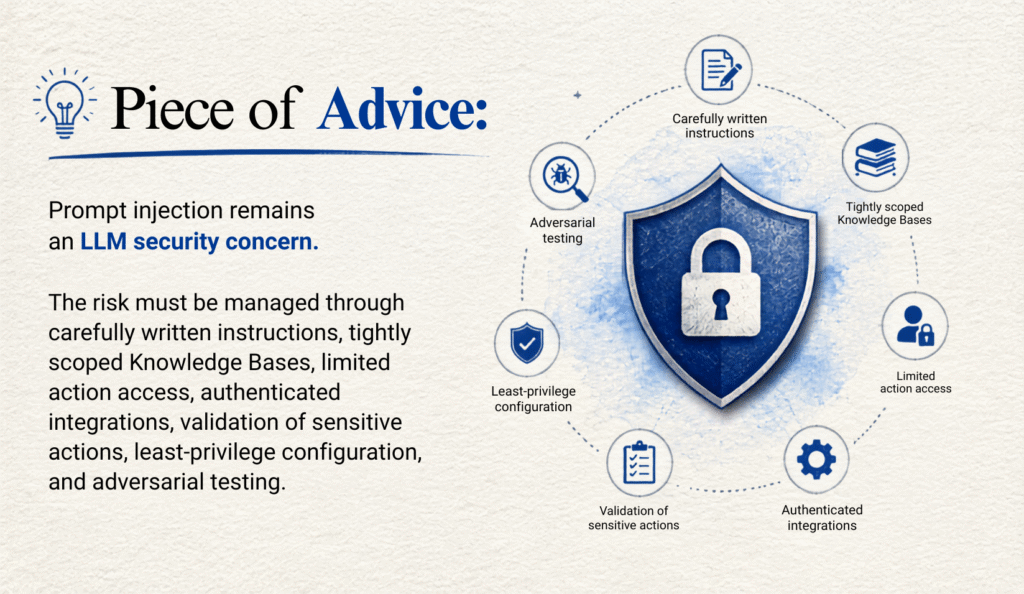
Prompt Injection Can Manipulate a Voice AI Agent’s Responses and Actions
The Problem We Found: A Voice AI agent can be exposed to prompt injection when a caller deliberately tries to override the agent’s instructions, manipulate its behavior, or get it to reveal information it shouldn’t.
The Consequence You Face: If the agent’s instructions, Knowledge Base, or connected actions aren’t carefully controlled, an attacker could potentially steer the conversation toward unintended behavior or sensitive information. This is especially important when the agent has access to CRM data or actions that can modify records or trigger workflows.
Our solution: Sharp AI provides role-based permissions that restrict which team members can access or modify Voice AI Agents, goals, Knowledge Bases, actions, and reporting. These permissions protect the agent’s configuration from unauthorized internal changes.
-
Latency and Poor Interruption Handling Can Make Voice AI Conversations Feel Robotic
The Problem We Found: Voice AI can feel unnatural when speech-to-text and text-to-speech introduce noticeable latency, especially when the caller starts speaking before the agent has finished responding. Poor interruption handling can also cause the agent to continue talking over the caller or lose the context of what the caller said.
The Consequence You Face: Even if the transcription is accurate, noticeable delays and failed interruptions make the interaction feel robotic. A caller may repeat themselves, talk over the agent, or become unsure whether the system is still listening.
Our solution: We provide the best AI Employee tools for configurable speech and agent settings, alongside Backchanneling and Noise Cancellation options that can improve conversational flow. Our AI agents in CRM systems assist in improving and testing voice interactions.
-
Callers May Not Know When They’re Speaking to an AI Agent
The Problem We Found: Callers may not realize they are speaking with an AI, especially when the Voice AI Agent sounds human. This becomes more sensitive when calls involve personal, financial, health, or employment information.
The Consequence You Face: If the caller discovers later that the interaction was with an AI, it can damage trust and create transparency or compliance concerns depending on the industry and jurisdiction.
Voice AI solution: For inbound calls, Sharp AI lets you configure the agent’s greeting, prompt, and conversational behaviour, so the agent can identify itself as an AI assistant at the beginning of the call and explain what it can help with.
INFOGRAPHIC: For outbound Voice AI calls, look for configurable AI disclaimer style as part of the outbound setup. These options support transparency, but they do not automatically satisfy every legal requirement. The business still needs to determine which AI disclosure, consent, call-recording, and data-handling requirements apply to its industry and jurisdiction.
-
Transcripts Can Miss Tone, Hesitation, and Changing Intent
The Problem We Found: A transcript captures the words spoken but loses much of the paralinguistic context, such as hesitation, tone, emotional cues, speaker changes, and how an answer evolves while someone is speaking. Intent can also change mid-sentence, so relying only on the final transcript may miss important conversational signals.
The Consequence You Face: If a business uses transcription as its only source of truth, it may overestimate the certainty of a caller’s response. For example, “I think… yeah, I can pay by the 15th” could appear as a firm commitment in text even though the caller sounded uncertain. That can matter when deciding whether to proceed automatically, verify information, or escalate to a human.
Voice AI solution: Sharp AI’s Voice AI Agent can use the live conversation to perform configured actions, including appointment booking, call transfers, workflow triggers, and contact-field updates.
Its documented Voice AI logs provide transcripts, recordings, execution details, latency, inputs/outputs, and errors, which lets teams review the actual call rather than relying exclusively on the transcript.
-
Transcription Accuracy Doesn’t Capture the Full Context of Sales Conversations
The Problem We Found: Voice AI systems are often evaluated by transcription accuracy, but in sales conversations, the delivery of an answer can provide context that the words alone don’t capture. A hesitant “yes,” a long pause, or a change in tone may indicate uncertainty even when the transcript looks like a clear commitment.
The Consequence You Face: If a business evaluates calls only through transcripts, it can miss conversational signals that could influence how a salesperson should follow up. A transcript might record the correct words while hiding the hesitation or uncertainty behind them.
Voice AI solution: Sharp AI’s Voice AI Agent gives teams access to the call recording alongside the transcript and execution data, allowing them to review not only what the caller said but how the interaction actually unfolded.
-
Plain Transcripts Can Miss Hesitation, Uncertainty, and Emotion
The Problem We Found: People want to capture nuances such as hesitation, uncertainty, or emotion that a plain transcript doesn’t represent.
Voice AI solution: Sharp AI does provide sentiment analysis for Voice AI calls, categorizing caller sentiment as positive, neutral, or negative. Teams can use that alongside transcripts, recordings, and call logs for quality review.
-
Transcripts Can Lose Emotional Context When Passed to the CRM
The Problem We Found: When a voice interaction is reduced to a transcript and passed into the CRM, the system can lose important context about the caller’s emotional state. Keeping sentiment separate from the transcript preserves the distinction between what the caller said and how the interaction was classified.
The Consequence You Face: If sentiment is mixed into the transcript itself, downstream systems and human agents may treat an inferred emotion as something the caller literally said. That can distort summaries, handoffs, reporting, and follow-up decisions.
Voice AI solution: Sharp AI provides positive, neutral, and negative sentiment analysis within Voice AI reporting. This gives teams a sentiment indicator that can be reviewed alongside call metrics, transcripts, recordings, and outcomes without rewriting the caller’s words inside the transcript.
-
Voice AI Can Fail When Frustrated Callers Need Human Escalation
The Problem We Found: For many small businesses using Voice AI as an appointment receptionist, the bigger operational risk isn’t losing subtle vocal cues. It’s failing to recognize when a caller needs human assistance. A frustrated customer who keeps repeating a problem or refuses the AI’s suggested solution can become more damaging if the agent keeps trying to handle the conversation.
The Consequence You Face: If escalation isn’t built into the call flow, the AI can trap the caller in a repetitive conversation, increasing frustration and potentially losing the lead or customer. For appointment-driven businesses, that failed handoff can matter more commercially than whether the system captured a caller’s exact emotional state.
Voice AI solution: Sharp AI’s Voice AI supports Call Transfer, allowing the agent to transfer an active call to a configured human destination. You can incorporate escalation instructions into the agent’s configuration, such as telling it to transfer when the caller explicitly asks for a human or when a defined situation requires human assistance. Sharp AI also supports Agent Transfer, which can move a caller between Voice AI Agents when that architecture makes sense.
This particular Agentic AI in CRM isn’t only about automating calls. A good implementation also needs a defined escalation path for calls the AI shouldn’t handle alone.