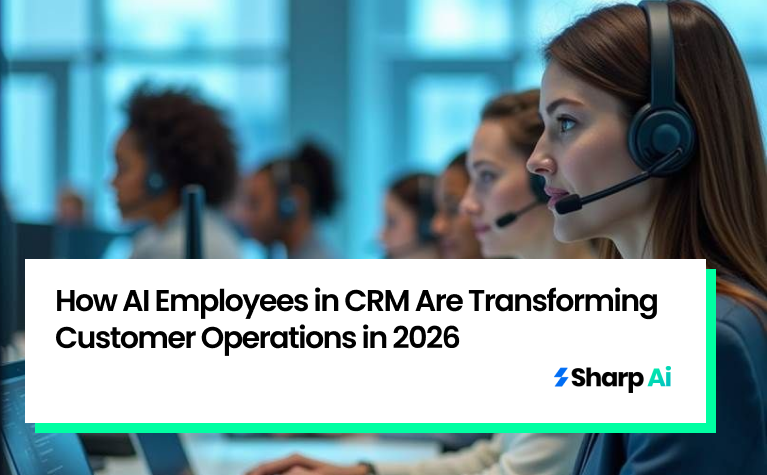
AI employees in CRM are changing customer operations in 2026 by turning CRM systems from places that simply store customer data into systems that can actively complete tasks and manage workflows. Instead of only suggesting what a team member should do next, AI Agents in CRM can handle parts of the customer journey with less manual input.
How AI Agents Are Changing Customer Operations
In 2026, CRM AI Agents are moving beyond simple reply generation. They can act as digital workers that manage complete tasks, connect information across systems, and take action based on set rules and customer data.
Key Changes in Customer Operations with AI Employees in CRM
- End-to-End Task Management: AI agents can independently handle tasks such as order tracking, cancellations, refunds, and appointment scheduling instead of only suggesting a response.
- Direct Access to Business Systems: Modern AI-Powered CRM Automation can use secure API connections to read and update information across CRM, ERP, billing, and customer support systems.
- Growing Business Adoption: Industry surveys report that up to 66% of organisations are actively using AI service agents, with strong adoption across sectors such as technology, telecommunications, and retail.
- Handling Rules and Unclear Situations: AI agents work well with predictable processes, such as checking whether a customer qualifies for a refund. However, human oversight is still needed when information is missing, policies conflict, or a situation requires judgement.
This is where CRM Automation with AI is changing the role of a CRM. Instead of simply recording what happened, an AI-enabled CRM can help carry out the next step in the customer process while keeping people involved where human judgement is needed.
Key Roles and Capabilities of AI Employees in CRM
AI employees in CRM can take on routine customer and sales tasks, helping teams manage more work without handling every step manually. These AI Agents in CRM can work across workflows, customer data, and communication tasks while leaving complex decisions to human team members.
-
Autonomous Task Execution
CRM AI Agents can manage routine workflows from start to finish. For example, they can score incoming leads, start follow-up sequences, update CRM fields, and schedule meetings without requiring a team member to trigger each action.
-
High-Volume Customer Triage
AI frontline agents can handle large numbers of repetitive customer questions instantly. This allows human teams to spend more time on complex issues, escalations, and customer relationships that need personal attention.
-
Cross-Departmental Data Sync
AI-Powered CRM Automation can collect, organise, and update customer interaction data across different systems. Platforms such as Salesforce Agentforce and HubSpot Breeze AI can reduce the need for manual data entry and help limit errors caused by manual CRM updates.
Together, these capabilities show how CRM Automation with AI can move beyond simple task automation. Agentic AI in CRM can help manage routine work, organise customer information, and keep workflows moving while human teams focus on tasks that require judgement and personal interaction.
Voice AI Agents for Small Business: Real Life Problems & Solutions
Measurable Business Impact of AI Employees in CRM
Using AI employees in CRM can improve the speed of customer operations, reduce manual work, and support better customer experiences. In 2026, businesses using AI Agents in CRM are measuring results through faster response times, higher customer satisfaction, greater workload capacity, and lower operating costs.
- Faster Resolution Times: AI agents can handle routine customer enquiries in under two minutes, making them much faster than many manual support processes.
- Higher Customer Satisfaction: Customer Satisfaction (CSAT) is one of the key performance measures improved by businesses using agentic AI tools, with 70% of businesses reporting it as their most improved KPI.
- Greater Workload Capacity: Advanced AI deployments, including Klarna’s AI assistant, can manage workloads that would otherwise require the capacity of hundreds of human support agents.
- Faster Return on Investment: Around 70% of organisations report seeing measurable financial or operational value within 60 days of deploying AI agents.
- Lower Operational Costs: AI-Powered CRM Automation can automate multi-step customer tasks, reducing the need for large tier-1 support teams and lowering the cost of handling individual enquiries.
These results show how CRM Automation with AI can be measured through real business outcomes rather than simply the number of automated tasks. For an AI Employee for Small Business or a larger organisation, useful measures include resolution time, CSAT, workload capacity, ROI, and cost per resolution.
Key Challenges of AI Employees in CRM
The main challenges of using AI employees in CRM in 2026 include connecting AI to older systems, maintaining reliable and unbiased data, managing security risks, controlling costs, and keeping the human side of customer service. Businesses using AI Agents in CRM need clear controls and regular checks to make sure automation works safely and effectively.
Integration and Legacy Systems
- Older technology: Businesses can find it difficult to connect autonomous CRM AI Agents with older software and systems.
- Vendor lock-in: Relying heavily on platforms such as Microsoft Copilot or Salesforce Agentforce can make it harder to change systems or providers later.
- Siloed data: When customer information is spread across disconnected databases, AI agents may not have the complete information needed to make accurate decisions.
Security and Governance
- Autonomous risks: Agentic AI in CRM can access external tools and stored information, creating new security risks if those connections are not properly controlled.
- Incorrect decisions: Advanced AI agents can produce answers that sound confident even when the decision is wrong, making human review important for sensitive tasks.
- Compliance requirements: Businesses using automated decision-making must follow relevant regulations, including rules such as the EU AI Act where applicable.
Data Quality and Bias
- Biased responses: AI models can repeat unfair patterns found in their training data, which may lead to different treatment of some customers.
- Changing data: Customer language, products, services, and business rules change over time. AI systems may therefore need regular updates to avoid relying on outdated information.
Costs and Business Value
- Higher operating costs: Running advanced multi-agent systems can require significant computing resources, which can increase the cost of AI-Powered CRM Automation.
- Uncertain ROI: Some AI projects take longer than expected to deliver financial returns. Businesses therefore need to measure whether CRM Automation with AI is producing enough value to justify its ongoing costs.
Human Touch and Customer Trust
- Robot-like experiences: Customers may become frustrated if an AI system follows rigid scripts instead of understanding what they actually need.
- Complex problems: AI agents can still struggle with unusual or complicated enquiries, meaning human staff may need to step in.
- Employee concerns: Customer support teams may see AI as a threat to their roles, which can lead to resistance or lower engagement.
For an AI Employee for Small Business or a larger organisation, these challenges show why AI should not simply be added to a CRM without planning. The technology needs reliable data, secure access, clear human oversight, and ongoing monitoring to deliver useful results.
Impact of AI Employees in CRM on Human Headcount and Roles
AI employees in CRM are changing how customer teams work rather than simply replacing large numbers of employees. As businesses use AI Agents in CRM to handle growing customer volumes, human roles are shifting towards supervision, quality control, and managing AI-driven workflows.
- No Mass Layoffs: Instead of using AI to reduce staff numbers, fast-growing companies are using AI employees to manage increasing customer demand while keeping their human headcount stable or continuing to grow.
- Changing Job Roles: Frontline support agents and quality analysts are increasingly moving towards roles such as automation supervisors and AI coaches. Their work focuses more on governance, setting safeguards, checking data quality, and monitoring how CRM AI Agents perform.
- Outcome-Based Pricing: Traditional CRM software pricing has mainly been based on the number of user seats. With CRM Automation with AI, pricing is increasingly moving towards usage-based or outcome-based models, where costs can be linked to the amount of work handled by AI agents.
Overall, AI-Powered CRM Automation is changing what people do inside customer operations. Rather than simply removing human roles, Agentic AI in CRM can shift employees towards overseeing automation, managing exceptions, and improving customer operations.