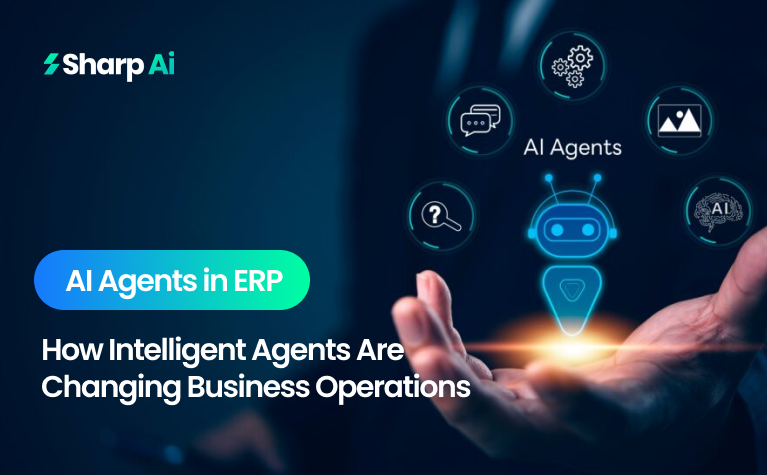
Business systems are becoming more proactive with AI Agents in ERP, moving away from automation that only follows fixed rules. These intelligent systems can work towards defined goals, respond to less predictable situations, and coordinate tasks across different areas of an ERP system.
What are AI Agents in ERP?
ERP AI Agents are autonomous software tools that operate within Enterprise Resource Planning platforms. They take in business data, work through several decisions, and use APIs to carry out transactions in the backend.
Core Capabilities of AI Agents in ERP in Business Operations
AI Agents in ERP can turn traditional enterprise resource planning systems from simple data repositories into proactive systems that independently manage complex, multi-step workflows.
- Autonomous Workflow Automation: ERP AI Agents can carry out detailed administrative and operational processes from beginning to end without a person manually starting each task. Examples include matching ledger entries and directing orders through the correct workflow.
- Natural-Language Interaction: AI Agents for ERP replace complex menu-based navigation with conversational commands. Systems such as SAP Joule and Oracle Digital Assistant can use these prompts to create reports and initiate tasks.
- Real-Time Anomaly Detection: ERP AI Automation can continuously monitor live business data and identify problems quickly, including budget overruns, transaction differences, and supply chain disruptions.
- Predictive Decision-Making: Intelligent Agents in ERP Systems can predict cash flow, inventory needs, and market trends. This allows them to help reroute logistics or recommend changes to suppliers before issues become larger.
- Cross-Functional Coordination: AI-Powered ERP Solutions can bring CRM and ERP data together, allowing processes to work smoothly across finance, supply chain, procurement, and human resources.
How AI Employees in CRM Are Transforming Customer Operations in 2026
ERP Workflow Automation with AI enables ERP AI agents to manage complex, context-aware workflows by making decisions, completing tasks, and handling exceptions across enterprise resource planning systems.
Key Use Cases of AI Agents in ERP by Business Area
AI Agents in ERP can automate tasks across finance, supply chain, procurement, sales, HR and IT. ERP AI Agents can work with business data, follow defined workflows and trigger actions with less manual input.
Finance and Accounting Operations
Accounts Payable (AP)
- Invoice processing: AI Agents for ERP can scan and interpret invoices automatically.
- Three-way matching: Match invoices against purchase orders and receiving records.
- Data validation: Check supplier and tax information before invoices move forward.
Accounts Receivable (AR)
- Email classification: Sort customer emails by intent, such as payment commitments or disputes.
- Payment matching: Match incoming payments to the correct invoices.
- Dispute management: Flag or create dispute records automatically when issues are detected.
Period Close Support
- Accrual data: Gather supporting information needed for period-end accounting.
- Expense detection: Identify recurring expenses and patterns.
- Journal entries: Recommend journal entries for review.
- Anomaly detection: Find unusual financial activity in real time.
Supply Chain and Inventory Management
Predictive Replenishment
- Demand forecasting: Analyse historical sales and seasonal trends to predict future demand.
- Supplier planning: Factor in supplier lead times when calculating stock requirements.
- Purchase orders: Generate purchase orders before expected shortages occur.
Continuous Planning
- Dynamic planning: ERP AI Automation can adjust production and distribution plans when demand changes.
- Supplier risk: Update plans when supplier lead-time problems create delivery risks.
- External signals: Use changing market or demand information to support planning decisions.
Logistics Optimisation
- Route monitoring: Track shipping routes and identify potential issues.
- Warehouse automation: Automate routine warehouse tasks.
- Supplier tracking: Monitor supplier performance using real-time information.
Procurement and Vendor Management
Requisition and Spend Control
- Budget checks: AI agents can compare purchase requests against company budgets.
- Policy checks: Verify requests against purchasing rules before approval.
- Approval routing: Send suitable requests to the correct person for approval.
Vendor Onboarding and Tenders
- Supplier setup: Help collect and organise information needed to onboard vendors.
- Compliance checks: Review supplier information against required standards.
- eTender management: Support electronic tender processes.
- RFQ evaluation: Help teams assess requests for quotation.
EDI Resolution
- Error detection: Identify failed or blocked electronic data interchange (EDI) transactions.
- Issue diagnosis: Investigate why a transaction failed.
- Resolution support: Help correct and resolve EDI problems.
Sales and Customer Operations
Proactive Issue Detection
- Order monitoring: Identify delayed orders or incomplete deliveries inside the ERP.
- Customer workflows: Trigger customer service workflows when an issue is detected.
- Proactive outreach: Start customer communication before a delivery problem becomes a larger issue.
Pipeline and Lead Management
- Lead scoring: AI-Powered ERP Solutions can score incoming leads based on available customer data.
- CRM updates: Automatically update pipeline information.
- Sales actions: Suggest data-driven outreach steps for sales teams.
Human Resources and Internal Operations
Onboarding and HR Administration
- New-hire onboarding: Coordinate onboarding tasks across multiple systems.
- PTO tracking: Track employee paid time off.
- Resume screening: Help screen incoming CVs against defined requirements.
- Employee support: Answer common HR and policy questions.
IT Service Management
- Access provisioning: Manage software permissions and access requests.
- Incident detection: Identify network incidents and potential IT issues.
- Device monitoring: Track device health and performance.
- Support tickets: Create contextual IT support tickets with the relevant information.
ERP AI Agents therefore have use cases across multiple business areas, from finance and procurement to HR and IT. With ERP Workflow Automation with AI, businesses can automate repetitive processes, connect information across departments and allow employees to focus on tasks that require human judgement.
How AI Agents in ERP Differ from Traditional Automation
AI Agents in ERP differ from traditional automation by moving ERP systems from fixed, rule-based processes to intelligent workflows that can work towards specific goals. While traditional automation follows set instructions, ERP AI Agents can understand context, process different types of information, and adapt their actions based on the situation.
Core Differences
- Rules vs. Goals: Traditional automation follows fixed if-then rules and predefined steps. AI Agents for ERP are goal-focused, assessing the situation, planning the required steps, and adapting their actions to reach the desired result.
- Data Processing: Traditional automation mainly works with structured data such as database fields and forms. Intelligent Agents in ERP Systems can also process unstructured and semi-structured information, including emails, PDFs, and natural language.
- Decision Making: Traditional automation is predictable, meaning the same input normally produces the same output. ERP AI Automation uses context and probability to assess different options and make decisions based on the information available.
- Handling Exceptions: Traditional workflows can stop when a situation falls outside their predefined rules. AI-Powered ERP Solutions can identify unusual cases, find possible ways forward, or send the issue to a human when needed.
ERP Workflow Automation with AI therefore allows business processes to move beyond fixed instructions and respond more flexibly to changing situations.
Major AI Agents in ERP Vendor and Their AI Capabilities
Major ERP vendors are adding AI Agents in ERP to automate business processes, assist with decisions, and connect AI directly to enterprise workflows.
Major ERP Vendor AI Capabilities
- Oracle Cloud ERP: Oracle offers AI Agent Studio with more than 50 built-in, process-focused agents at no extra cost, along with an AI Agent Marketplace for partner-built workflows.
- SAP: SAP uses Joule for enterprise automation, with more than 2,400 skills, as well as Joule Studio. Its AI services use a consumption-based pricing model through AI Units.
- Microsoft Dynamics 365: Microsoft integrates Copilot and Copilot Studio across Microsoft 365 and Power Platform. Its capabilities also support multi-agent workflows, with the add-on priced at around $27 to $37 per user per month.
- Odoo: Odoo includes built-in machine learning and a Natural Language Assistant designed to support mid-market business needs.
Core Enterprise Use Cases
- Order-to-Cash: ERP AI Agents can support order capture through natural language prompts, inventory allocation, and order tracking.
- Procure-to-Pay: AI Agents for ERP can process documents using OCR and match invoices with purchase orders through trained domain language models.
- Finance and AP/AR: ERP AI Automation can support accounts payable and accounts receivable tasks, flag exceptions, and assist with financial reconciliations.
- Operations and Supply Chain: AI-powered ERP systems can use machine learning for demand forecasting and inventory optimisation.
Adoption Bottlenecks and Governance
- Runtime Governance: ERP AI projects can face delays during security reviews when systems do not provide immutable audit logs, strict role-based access controls (RBAC), or clear records of how decisions were made.
- Human-in-the-Loop: Most production implementations in 2026 still require human confirmation before Intelligent Agents in ERP Systems can perform financially or operationally important tasks.
AI-Powered ERP Solutions therefore combine intelligent automation with governance controls, while ERP Workflow Automation with AI helps connect these capabilities to everyday business processes.