By 2029, Agentic AI will autonomously resolve 80% of common customer service issues without human intervention, thereby reducing operational costs by 30%.
Depending on AI employees in CRM to deal with clients where an in-depth understanding of each customer’s unique buying journey, preferences, and behaviors is a risk, businesses like yours are ready to take.
This brings us to the inevitable discourse of AI employees in transforming customer relationship management. The AI employees of 2025 are well-equipped in automating lead qualification, analyzing massive amounts of customer data, and delivering personalized experiences at scale.
But does that leave the sales taskforces isolated? No, this would enable sales teams to focus on closing deals and firming up relationships with customers.
In order to better understand the integration of AI employees in CRM, Sharp AI recommends reading this blog so that the next time you plan on hiring a virtual team, you know the pros and cons.
What Are AI Employees?
Why do I need AI employees if I have a CRM? Congratulations, you’re thinking right. To answer your question, you need to think of AI employees as Robin and CRM as Batman. Batman is the brain and Robin is the body. The CRM holds all the information ready at the drop of a hat and the AI employees transform them into genius ideas and strategies that benefit you and your business.
AI employees are designed to perform specialized tasks, analyse large volumes of customer data, identify patterns, and make data-driven decisions.
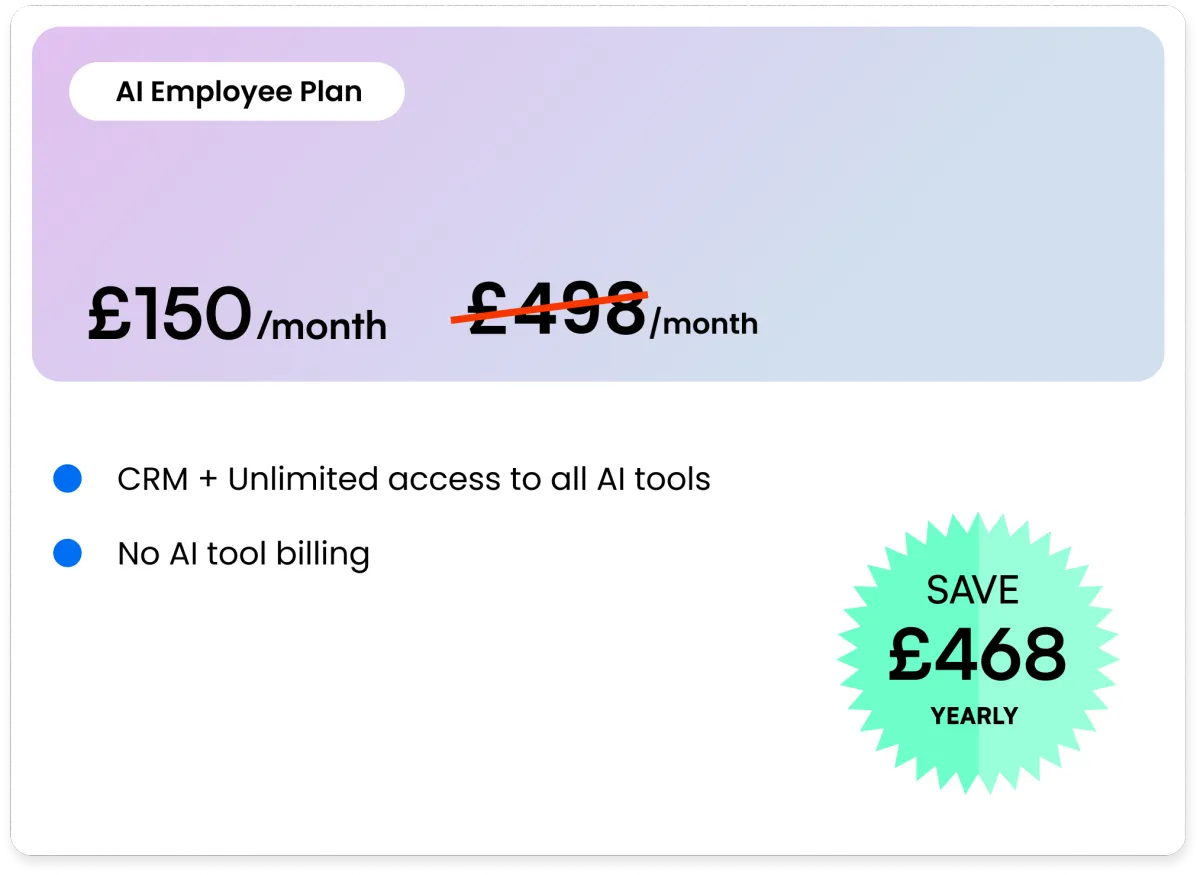
What functions can AI employees in CRM perform?
Speaking about CRM, AI employees may possess different types of positions:
- Sales Forecasting: AI can analyze the historic data of sales, patterns of customer behaviors, and trends in the market to project sales and predict revenue growth. This helps businesses make better predictions concerning future sales, hence improving resource allocation and decision-making.
- Customer Reporting and KPIs: AI automatically generates custom reports on KPIs, sales funnels, and CRM metrics, presenting personalized insights into the tracking of business objectives and real-time performance.
- Lead Qualification: Leads are automatically analyzed and scored based on the potential of the lead converting.
- Sales Enablement: Automate outreach and follow-up; deliver customized recommendations to prospects.
- Predictive Analytics & Insights: AI finds the leading trends and patterns in customers’ activities, using which the sales teams can reach out to their customers at the most opportune timing for the best chance of success.
- Customer Support: Standard queries, ticket handling, and 24×7 support.
How long is the ROI period after implementing AI employees in CRM for sales?
The typical ROI period for AI in CRM is 6 months to 2 years, depending on the scale of the deployment and the business.
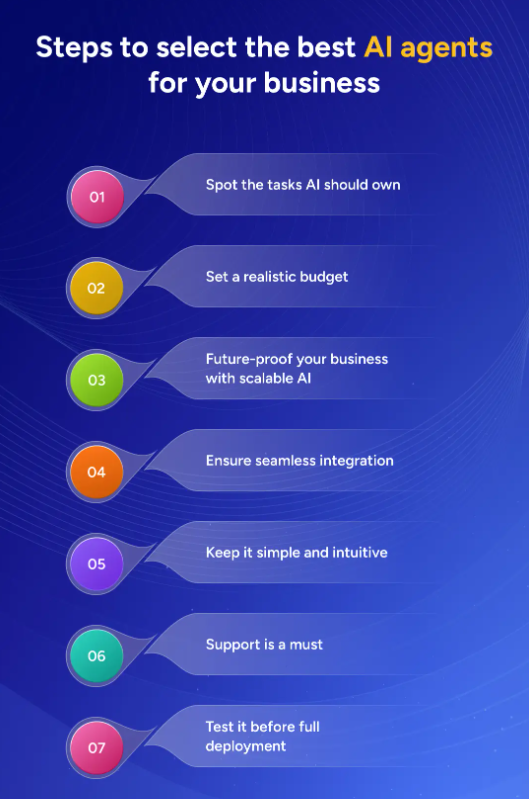
How to measure success when implementing AI employees into sales CRM?
Key performance indicators to track the success of AI in customer relationship management:
- Lead Scoring Accuracy: How well is AI identifying high-value leads?
- Sales Cycle Time: AI is expected to reduce the time it takes to close deals.
- Customer Retention: The capability of AI to keep long-term relationships, therefore increasing retention rates.
- Response Time: The time it takes for AI to answer customer inquiries or perform tasks, including follow-ups and lead qualification.
- Data accuracy: It monitors the cleaning and maintenance of the customer data by AI.
- Customer Satisfaction: The measurement of the after-interaction experience of customers, including NPS or CSAT scores.
- Revenue Growth: This reflects how AI influences overall sales performance, mainly if it’s linked to customer behaviors and lead nurturing.
How to decide which stage of the sales cycle should be handled by AI employees?
A classic decision framework that helps one decide which tasks to automate with AI-Powered CRM Solutions and which to retain as human-driven includes:
- Repetition: If a job is repetitive in cycles-for example, data entry, lead scoring, basic customer service-it lends itself to AI automation.
- Data Complexity: Activities that require sophisticated human judgment, like negotiations, complaints handling, or high-value sales, have to be driven by humans.
- Volume vs. Quality: If the process requires high-volume, low-touch interactions, for example, first-contact responses and marketing automation, AI would be better suited. In cases where customer relationships are to be high-touch and personalized, human employees should be used.
- Customer Service: The customer’s experience requires a human in cases of problems that are either complex or sensitive, hence needing emotional intelligence, empathy, or personal rapport.
- Cost Efficiency: A task in which AI can drastically reduce the cost involved, thereby increasing efficiency for the same or better quality, is likely a good candidate for automation.
What kind of business size is ideal for implementing AI employees in CRM?
Mid-market businesses and large enterprises are ideal for AI employee adoption as they have established processes, high volume of customers, multiple sales teams, and complex data.
What happens when the AI employee makes a mistake in the CRM?
When and if the AI employee makes an error, an AI-powered CRM system, like Sharp AI, notifies the human agent for correction and review. Once the error and correction are in the system, the AI-powered CRM will then train the AI employee to correct patterns, and avoid similar errors in the future.
What is the cost of implementing AI employees in a CRM?
| Initial Cost | Ongoing Cost |
|---|---|
| Initial costs can include the purchase of AI software, integration with existing CRM, and the customization required to tailor the system to the business’s needs. These costs may vary from a few thousand dollars to hundreds of thousands, depending on the scale and complexity of the implementation. Training employees to use the new system also adds to the initial costs.
|
Ongoing costs typically include maintenance, updates, data storage, and any subscription fees for AI tools or cloud services. There may also be costs for monitoring AI performance and ensuring it is learning and evolving.
|
Can AI Employees Boost Sales in CRM?
1. Qualified Lead Automatation
AI employees significantly improve sales in CRM by automating the lead qualification process. Conventionally, sales teams have been spending a good amount of time and effort sorting leads to get those most likely to convert. AI employees cut down on time and effort factors with real-time data and scoring leads-based analysis on their likelihood of conversion.
The AI employees also analyze customer behaviours, such as the frequency of visiting websites, contact via social media, and past purchase history. This helps them in prioritizing high-quality leads to make sure sales teams invest effort and time in prospects.
Suggested Read: https://blog.sharpai.app/what-is-crm-crm-systems/
2. Personalization of Customer Interactions at Scale
The secret sauce that keeps customers for life is personalization. AI employees are trained for excellence in the delivery of experiences that will be personalized to customers’ tastes, behaviors, and interests through messages, emails, or content.
Whether it is suggesting relevant products based on previous purchases or sending timely follow-up emails, AI employees make sure relevant information reaches each customer. For this reason, personalization has become one of the key differentiators in customer relationships, and AI employees can provide much greater personalization at scale.
3. Predictive Analytics for Sales Forecasting
AI workers are also very good at predictive analysis in sales trends for better sales forecasting. By analyzing previous data, customer behavior, and market trends, AI will be able to estimate the likeliness of a lead to transform into a customer and provide data on future revenue growth.
That would enable a business to use its resources more effectively, set more realistic sales targets, and hence find newer opportunities. Sales teams will channel their energies toward high-potential prospects for an overall better sales strategy and maximum likelihood of hitting targets.
4. 24/7 Customer Engagement
AI-powered chatbots and virtual assistants provide around-the-clock engagement for customers by answering their queries, resolving problems, and even suggesting products. Such depth of engagement ensures that no lead gets missed, and customers receive instant responses.
In other words, AI employees support increasing customer satisfaction and decreasing the response time by being able to interact with prospects 24/7, hence impacting sales success.
5. Smooth Sales Process and More Insights
AI employees can handle large volumes of data with both high precision and speed. This, in turn, enables the sales teams to deal with actionable insights that are important for refined business strategies, thus guaranteeing better performance of sales teams. In this respect, carrying out day-to-day mundane tasks allows AI employees to empower sales teams toward making better decisions, connecting more with customers, and driving increased sales.
Benefits and Challenges of Implementing AI Employee in CRM
| Benefits | Outcomes | Challenges | Outcomes |
| Increased Efficiency | AI employees can automate repetitive tasks like data entry, lead qualification, and follow-ups, increasing sales productivity by up to 20%. | Data Privacy and Security
|
AI employees handle voluminous customer data, which becomes a serious concern for data privacy and security. Ensuring compliance with regulations like GDPR and CCPA will be very crucial. |
| Better Customer Experience | With AI, customers get personalized, real-time interactions to boost their satisfaction and improve retention and sales growth. | Integration with Existing Systems | Integrating AI employees into legacy CRM systems can be intricate, requiring seamless integration and potential disruptions to ongoing operations.
|
| Higher Conversion Rates | AI automates personalized outreach and enhances lead qualification for higher conversion rates of prospects into customers. | Employee Adoption and Training | Sales teams will also be resistant to relying on AI due to the fear of replacing human roles. This requires proper training with regard to the value of AI.
|
| Improved Sales Insights | AI workers mine data to provide valuable insights that help companies in strategy refinement, predicting trends, and prioritizing high-value leads to make decisions more effectively. | Continuous Learning and Optimisation | AI systems need updating and addition of new data continuously to improve their precision. Without continuous learning, AI becomes outdated and not as productive.
|
| Efficient Sales Process | AI, through its integration with a CRM system, automates lead nurturing and lead prioritization to provide valuable insights that enhance operational efficiency and customer satisfaction. | Human Touch
|
AI lacks empathy and emotional intelligence, and many complex or sensitive customer interactions just cannot be fully handled without human agents as part of some hybrid model. |
Grow with Sharp AI
You’re already one step ahead with CRM integration, why not make a ten step leap with the implementation of AI employees? With Sharp AI, you get an offer that’s impossible to refuse. Sharp AI brings you its AI Employee Plan – you get Sharp AI CRM + AI Agents. That’s not all! You get 15+ tools in 1 platform and save 24%!
Book a demo with Sharp AI to access this tempting offer.