The discourse online on CRM agents is confusing and complex. Sharp AI brings you a well-informed guide on CRM agents and tools to help you implement the right AI employees that assure benefits and drive your business towards achieving tenfold Return On Investment (ROI). Without further ado, let’s scroll to read the entire blog!
Key takeaways
- What are CRM agents?
- CRM Agents vs Traditional CRM Systems
- 7 Key Benefits of CRM Agent Technology
- How CRM Agents Power Smarter Sales and Customer Service?
- Essential Features of Modern CRM Agent Platforms
- How Sharp AI CRM Powers Intelligent Agent Workflows
- 4 Steps to Implement CRM Agent Technology
- The Future of Sales and Service: Why CRM Agent Technology Matters Now
What Are CRM Agents?
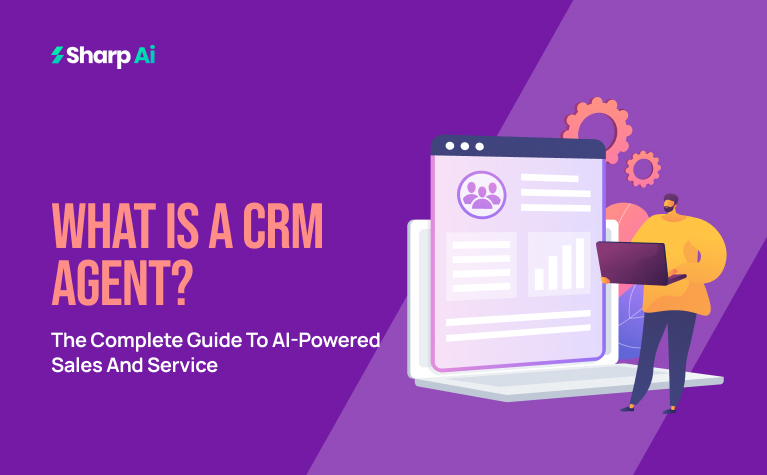
CRM agents are AI-powered digital assistants built into Customer Relationship Management (CRM) systems. These agents automate tasks, provide helpful insights in real-time, and make work easier for human agents. They can handle routine questions, analyze customer data to predict behaviors, and personalize interactions. CRM agents also help execute complex workflows, allowing employees to focus on more important tasks like building relationships and making strategic decisions.
CRM agents are a key part of CRM automation, improving customer support and helping businesses grow by streamlining customer management and sales processes. They reduce the need for manual work and enhance the overall efficiency of CRM systems.
CRM Agents vs Traditional CRM Systems
CRM agents are smart, AI-powered systems that help automate tasks, provide insights, and adjust to different situations. They go beyond just storing data and can learn and make decisions. In contrast, traditional CRM systems mainly store data and rely on manual, rule-based automation, meaning they follow fixed instructions like “if this happens, do that.”
Here’s how they compare:
| Feature | Traditional CRM | AI-powered CRM Agents |
| Core Function | Data storage and management | Intelligent automation and proactive action |
| Automation | Rule-based, rigid (e.g., “if this, then that”) | Intelligent, adaptive, and learning |
| Data Handling | Manual data entry, can be inconsistent | Automated capture, cleaning, and enrichment |
| Insights | Requires human analysis | Analyzes patterns, predicts outcomes, suggests actions |
| Task Execution | Needs human intervention | Can handle workflows and solve problems on its own |
| Examples | Salesforce, Microsoft Dynamics 365 | SuperAGI’s platform, AI features in HubSpot |
Key Differences
Intelligence and Adaptation
Traditional CRMs work with set rules, which can get outdated. CRM agents use machine learning to adapt to new data and make smarter decisions over time.
Data Management
Traditional systems need manual input, which can cause errors. CRM agents automatically clean and update data, making customer information more accurate.
Proactive vs. Reactive
Traditional CRMs are reactive—they just store info and perform manual tasks. CRM agents are proactive, using data to spot opportunities, predict problems, and take action without needing constant direction.
Efficiency
CRM agents help reduce manual work, allowing human agents to focus on more important tasks. AI-powered systems often improve productivity and lower costs compared to traditional systems.
7 Key Benefits of CRM Agent Technology
CRM (Customer Relationship Management) agent technology offers many advantages for businesses, helping them improve efficiency, communication, and overall customer experience. Here’s how CRM systems can benefit your business:
1. Centralized Data Management
A CRM system gathers all customer information in one place. This includes contact details, past interactions, and preferences, making it easy for sales, marketing, and service teams to access the most up-to-date data. This centralization supports efficient CRM agent roles and CRM agent responsibilities.
2. Improved Efficiency Through Automation
CRM automation powered by AI can automate repetitive tasks like entering data, scheduling meetings, and sending follow-up emails. This allows CRM agents for business growth to focus on more complex tasks and important customer interactions.
3. Enhanced Client Communication
With a CRM, agents have a full history of customer interactions, enabling them to provide personalized and timely responses. This leads to better communication and smoother customer experiences, a crucial aspect of CRM agent duties and responsibilities in customer service.
4.Data-Driven Insights
CRM systems offer powerful tools like dashboards and analytics to track customer behavior, sales trends, and market data. These insights help businesses make smarter decisions and plan for future growth, providing valuable sales CRM and CRM agent training for sales professionals.
5. Streamlined Processes
CRM agents help simplify processes like managing leads and handling transactions. They ensure nothing is missed, and follow-ups are consistent and well-organized, making the entire workflow more efficient. This streamlining supports CRM agent responsibilities and makes customer support more responsive.
6. Scalability
As a business grows, a CRM system can scale with it. It can handle more customer interactions, data, and team members without losing its effectiveness. This ensures that automated CRM systems for customer management grow alongside your business.
7. Competitive Advantage
By using CRM agent technology, businesses can gain an edge over competitors. CRM automation combined with personalization and data insights enables companies to offer better customer service, which is harder to achieve with manual processes. This provides a significant competitive advantage in a crowded market.
How Do CRM Agents Enhance Sales and Customer Service?
Sales and support teams are always under pressure to do more with less: faster responses, better customer relationships, and smoother teamwork. But with limited resources, growing demands often lead to stress or missed opportunities. This is where CRM agents step in.
These smart digital tools don’t just automate tasks they change how you engage with customers and boost growth. They free up your team to focus on high-priority tasks while improving every interaction. Here’s how CRM agents improve sales and customer service.
-
Automating Sales Development for Faster Growth
Your sales team spends hours on tasks like outreach and scheduling meetings. CRM agents handle these routine tasks, ensuring high-quality interactions. They identify leads, send personalized messages, and even schedule meetings. When a lead responds, the CRM agent knows whether to keep the conversation going or hand it off to a human. With Sales CRM features like AI Blocks, your team can instantly categorize leads and extract key info without sifting through emails.
-
Delivering Smarter, Context-Aware Customer Support
CRM agents help manage the growing number of support tickets. They provide instant responses to common questions and route more complex issues to the right experts. These agents don’t just match keywords; they understand the context of each request. If a customer mentions trouble with an update, the CRM agent knows their account history, which version they’re using, and any previous solutions. This ensures a faster, more personalized service experience.
-
Proactive Engagement to Prevent Churn
CRM agents help spot issues before customers express dissatisfaction. They monitor usage patterns and engagement levels, identifying potential problems early. If a customer’s activity drops or their renewal date is nearing, the agent automatically sends helpful resources, schedules follow-up calls, or offers incentives. This proactive approach reduces churn and improves customer retention.
-
Real-Time Performance Insights for Sales Leaders
Sales managers need quick insights to keep teams on track. CRM agents provide continuous analysis of team performance and deal progress, eliminating the wait for monthly reports. You’ll get daily insights into which reps need coaching, which deals are stuck, and what actions could improve results. CRM agents even suggest next steps based on past successful patterns, helping your team stay on top of their goals.
CRM agents streamline workflows, improve customer interactions, and give sales and support teams the tools they need to drive business growth. By automating tasks and providing valuable insights, CRM agents allow businesses to focus on what matters most—building strong customer relationships.
Essential Features of Modern CRM Agent Platforms
Modern CRM agent platforms offer a range of features to help businesses manage customer relationships and improve efficiency. Here are some of the key functionalities:
-
Contact and Lead Management
CRM platforms store customer details, interaction history, and lead information in one centralized place, making it easy to access and update important data. This helps sales and support teams manage customer relationships more effectively.
-
Interaction Tracking
CRM systems track all customer interactions, including calls, emails, and meetings, ensuring that every touchpoint is recorded and easily accessible for future reference.
-
Sales and Marketing Automation
CRM agents automate routine tasks like email sequences, follow-ups, and campaign management, saving time and streamlining business processes. This automation supports CRM system functions by reducing manual work for sales teams.
-
Email Integration
A deep connection with email clients allows CRM systems to track, manage, and respond to communications directly within the platform, improving efficiency in customer interactions.
-
Document Management
CRM platforms securely store customer-related documents, making it easy to access important files and ensuring compliance with data protection regulations.
Advanced and Modern Features
- AI and Predictive Analytics
Artificial intelligence helps predict customer behavior, score leads, and forecast sales, giving businesses a clearer view of future opportunities and challenges.
- Omnichannel Communication
Modern CRM systems allow businesses to manage interactions across multiple channels (email, chat, social media, and phone) in a single interface, offering a unified experience for customers and agents alike.
1. Seamless Integration
CRM platforms integrate with other business systems like ERPs and marketing tools, creating a central hub for customer data that supports better decision-making.
2.Reporting and Analytics
Real-time, customizable dashboards and reports provide businesses with actionable insights into performance, helping teams track progress and identify areas for improvement.
3. Personalization
By using customer data, CRM systems enable businesses to personalize interactions and create targeted marketing campaigns, leading to better customer experiences and higher engagement.
4. Mobile Access
CRM platforms provide mobile access, allowing sales and support teams to manage customer data and complete tasks on the go, ensuring productivity no matter where they are.
5. Task and Workflow Automation
Automating business processes ensures tasks are completed on time and reduces the chance of errors, improving overall team efficiency and ensuring smooth operations.
Modern CRM platforms, with their combination of CRM automation, AI capabilities, and seamless integrations, are powerful tools that help businesses grow and provide better customer service.

Key Ways Sharp AI Powers Intelligent Agent Workflows
Sharp AI CRM powers intelligent agent workflows by using AI agents to automate tasks, provide real-time insights, personalize customer interactions, and enable autonomous decision-making. This transforms the CRM from a data repository into a proactive system that enhances efficiency and customer experience without constant human intervention.
Task Automation
Sharp AI agents handle repetitive and time-consuming administrative tasks, such as data entry, scheduling follow-ups, and managing support tickets. This frees up human agents to focus on high-impact activities like closing deals and building complex customer relationships.
Intelligent Lead Management
The platform automatically scores and prioritizes leads based on their engagement, behavior, and potential to convert. This ensures sales teams focus their efforts on the most promising prospects, leading to higher conversion rates and a faster sales cycle.
24/7 Customer Engagement
AI sales agent CRM software , including conversational AI and voice AI, provide instant, round-the-clock customer support. They answer common questions and route complex issues to human agents, reducing response times and improving customer satisfaction.
Personalized Communication
Sharp AI analyzes customer data to generate personalized content for emails, social media, and websites. This tailored approach makes every interaction feel more relevant and human, strengthening customer loyalty and engagement.
Predictive Analytics and Insights
The system uses machine learning to analyze past data and current trends to provide actionable insights. This includes sales forecasting, identifying potential customer churn, and suggesting the “next best actions” for agents, enabling data-driven decision-making.
Workflow Orchestration
AI agents can coordinate and execute multi-step processes by working together or with third-party tools. For example, one agent might research a prospect while another drafts an email and a third schedules a meeting, creating a seamless, automated workflow.
No-Code Configuration
Sharp AI is designed with a user-friendly, no-code interface for building and customizing AI agent workflows, making it accessible to non-technical users.
In essence, Sharp AI empowers intelligent agent workflows by transforming data into strategic action, allowing for a more efficient, scalable, and personalized approach to customer relationship management.
4 Steps to Implement CRM Agent Technology
Implementing CRM agent technology involves four key steps:
Define your goals
Decide what you want to achieve with your CRM system, like improving sales or customer service.
Align your team
Ensure the needs of everyone involved especially customers and customer-facing employees are considered in the CRM agent roles and responsibilities.
Get executive support
Make sure top management is actively supporting the project, as CRM automation initiatives require strategic buy-in.
Choose the right CRM
Research and compare different CRM systems to find the one that fits your goals and needs.
Customize wisely
Tailor the CRM system to your business processes, but avoid over-customization. Too many changes can cause delays and raise costs.
Integrate your systems
Connect your CRM with existing tools for smooth workflows and sales CRM automation.
Migrate your data
Make sure your customer data is accurate and clean before transferring it to the new CRM system.
Train your team
Ensure everyone understands CRM agent duties and responsibilities in customer service with proper training.
Rollout the system
Use a phased rollout schedule to manage the transition. After going live, continuously monitor performance to improve CRM automation and track CRM agent responsibilities.
The Future of Sales and Service: Why CRM Agent Technology Matters Now
CRM agent technology is becoming essential for businesses today because it uses AI to automate routine tasks, customize customer interactions, and provide a complete view of customer data across departments. This helps increase sales efficiency and improve customer satisfaction.
By automating tasks like lead qualification, data entry, and follow-ups, AI agents allow human teams to focus on more complex tasks that require emotional intelligence. This shift towards CRM automation is crucial in a digital-first world where customers expect quick, personalized, and proactive support.
FAQs
-
What does a CRM agency do?
A CRM agency helps businesses set up and optimize CRM systems to manage customer relationships, automate tasks, and boost sales.
-
What is a CRM with examples?
A CRM (Customer Relationship Management) system helps manage customer data and interactions; examples include Salesforce, HubSpot, and Sharp AI CRM.
-
What does a CRM person do?
A CRM person manages and uses CRM systems to improve customer relationships, track sales, and analyze data for better decision-making.
-
What are the 4 types of CRM?
The four types of CRM are operational, analytical, collaborative, and strategic, each focusing on different aspects of customer management.
-
Is CRM difficult to learn?
CRM systems are easy to learn, especially with intuitive platforms like Sharp AI CRM, which provide AI-powered automation and simple user interfaces.
-
What are the 4 principles of CRM?
The four principles of CRM are customer-centricity, data-driven insights, effective communication, and continuous improvement.
-
Which CRM is best for beginners?
Sharp AI CRM is ideal for beginners, offering easy-to-use features with AI automation and sales CRM tools that simplify customer management.
-
What is the most popular CRM?
The most popular CRM is Salesforce, but Sharp AI CRM offers unique AI-driven features that enhance customer support and sales automation.
-
What is the simplest CRM to use?
Sharp AI CRM is one of the simplest CRMs to use, providing an intuitive interface with smart AI tools for task automation and customer support.