Table of Contents
- What are AI Agents?
- What is a CRM?
- Types of AI Agents into CRM
- Key Benefits of AI Agents in CRM
- Challenges of Integrating AI Agent into CRM
- FAQs
A few years back, terms such as AI agents and AI-powered employees sounded like someone spoke the 2050 language. Who knew the world would advance so fast that it all became a norm in 2025. Not everyone is ready to embrace the change, but you should!
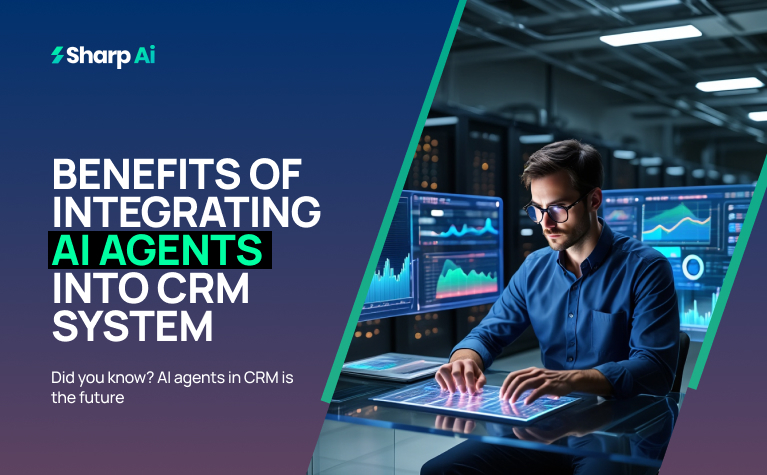
If you’re using a system to control and secure your data, get AI employees. Integrating AI agents in CRM system is the same as providing soldiers (aka your team) with advanced machinery (aka working systems). The purpose is to win, no?
In this blog, Sharp AI commits to educating its audience (aka you) on AI Agent tools that, contrary to popular belief, are actually secure and reliable. Here are a few basics for you to go over.
What Are AI Agents?
AI agents are smart software programs that can make decisions and perform tasks on their own. They can collect information, analyze it, and take actions to meet specific goals set by humans.
For example, a CRM AI agent in customer service might automatically ask customers questions, search through documents to find answers, and provide solutions without needing human help. If the AI can’t solve the problem, it will pass the task to a human.
AI agents can also work together to automate more complex tasks. These agents can share data and collaborate to achieve common goals. Some AI agents are designed to perform specific tasks, while others, called orchestrator agents, manage and coordinate the work of multiple agents to complete larger tasks.
In a CRM system, AI agents for sales automation can improve CRM automation by helping businesses respond to customer inquiries faster, personalize interactions, and automate repetitive tasks. This makes customer support more efficient and enhances the overall CRM automation with AI for customer support process tenfold better.
What is a CRM?
A CRM (Customer Relationship Management) system helps businesses manage all their interactions with current and potential customers. It’s a tool that allows companies to organize, automate, and streamline processes like sales, marketing, and customer service to build better relationships and drive growth.
Businesses of all sizes and industries use CRM systems to improve their performance. Sales teams, marketing departments, and customer service agents all rely on CRM to stay organized, track customer information, and improve communication.
With the help of AI-powered CRM and CRM automation, businesses can also enhance customer support and sales automation. By integrating AI agents into CRM, companies can gain better customer insights and make smarter, more efficient decisions.
Types of AI Agents in CRM
AI agents can be divided into several types based on how they make decisions and perform tasks. The main types are:
-
Simple Reflex Agents
These agents make decisions based only on the current input, following basic “if-then” rules without considering past actions or experiences.
-
Model-Based Reflex Agents
These agents keep track of past actions and events using an internal model. This helps them make better decisions based on things that aren’t immediately visible.
-
Goal-Based Agents
These agents act to achieve a specific goal. They think ahead about what actions will help them reach that goal and make decisions accordingly.
-
Utility-Based Agents
These agents go beyond simple goals by considering the “utility” or value of different outcomes. They choose the action that brings the most benefit or is most desirable.
-
Learning Agents
These agents improve over time by learning from their experiences. They update their internal models and strategies to perform better in the future.
-
Hierarchical Agents
These agents work in layers. High-level agents make plans, while lower-level agents carry out the tasks to achieve those plans.
-
Multi-Agent Systems
These involve multiple agents that interact with each other in a shared environment. They can work together or compete to achieve their individual or collective goals.
Key Benefits of Integrating AI Agents in CRM Systems
1. Automate Repetitive Tasks
AI agents in CRM can handle routine tasks like data entry, scheduling, and sending follow-up emails. By automating these repetitive actions, AI agents free up human agents to focus on more important customer interactions. This CRM automation ensures that data stays accurate and up-to-date, helping your team save time and reduce errors. Using an AI-powered CRM, businesses can automate email responses and track follow-ups to make sure no lead is overlooked.
2. Provide Insights into Customer Behavior
One of the main benefits of AI agents in CRM systems is their ability to analyze large amounts of customer data. By looking at purchase history, engagement trends, and preferences, AI agents generate valuable insights that help businesses understand their customers better. These insights allow for personalized offerings and targeted marketing, improving customer engagement and boosting sales.
3. Improve Customer Engagement
AI agents in CRM help businesses engage with customers at scale. They personalize interactions based on customer history, preferences, and behavior. For example, AI can send custom emails, recommend products, and even hold real-time, context-aware conversations. This ability to tailor messages helps build stronger customer relationships and encourage repeat purchases. Personalized CRM automation with AI for customer support also ensures timely and relevant communication.
4. Predict Customer Needs or Behaviors
AI agents can predict future actions by analyzing past data, such as whether a customer is likely to make a purchase or leave the brand. These predictions allow businesses to act before the customer disengages, offering personalized re-engagement strategies. This proactive approach increases customer loyalty and helps businesses stay ahead of trends, improving CRM efficiency.
5. Enable Real-Time Customer Support
AI agents in CRM like chatbots are available 24/7 to answer common questions, process orders, and provide troubleshooting. When customers have more complex queries, AI agents can hand off the conversation to a human agent with all relevant information. This AI for customer support ensures fast response times and enhances customer satisfaction.
6. Personalize CRM Strategy
Advanced AI agents in CRM analyze customer data to personalize marketing campaigns, product suggestions, and offers. By creating segments in your CRM system, such as repeat buyers or high-value customers, AI can help businesses target their messages effectively. This CRM automation helps increase engagement and conversion rates by delivering relevant content and products.
7. Improve Lead Scoring and Qualification
AI agents use data from customer interactions, demographics, and behavior to score leads based on their potential to convert. AI agents for sales automation in CRM allow sales teams to prioritize high-quality leads, improving sales efficiency and closing rates. With AI-powered CRM, the system continuously refines lead scoring to ensure that sales teams focus on the most promising opportunities.
8. Reduce Churn in CRM
AI agents can predict which customers are at risk of leaving by tracking engagement and satisfaction metrics. This allows businesses to act early, offering personalized support, special discounts, or exclusive products to re-engage customers. AI helps businesses reduce churn by providing early warnings and making proactive outreach easier. With CRM systems powered by AI, businesses can keep customers loyal.
9. Keep CRM Data Accurate and Secure
AI agents ensure that CRM data is accurate by automatically verifying and updating information, removing duplicates, and correcting errors. They also monitor for unusual activity, identifying potential security threats and alerting the appropriate teams. This continuous monitoring not only improves data accuracy but also builds customer trust by maintaining secure and reliable data.
Challenges of Integrating AI Agents into CRM Systems
Integrating AI agents in CRM systems can bring significant benefits, but it also presents several challenges. These challenges include data quality issues, technical compatibility with legacy systems, and a shortage of skilled workers. Other hurdles include ensuring data privacy, managing costs, and overcoming employee resistance to change. Ethical concerns, such as algorithmic bias and ensuring the accuracy of AI agents, are also important considerations.
Data-related Challenges:
Poor data quality
If your CRM data is inaccurate, inconsistent, or incomplete, AI agents will not perform well. AI agents rely heavily on the quality of the data they receive to provide useful insights and automate tasks.
Data privacy and security
When integrating AI agents in CRM systems, businesses must carefully protect sensitive customer data to meet privacy regulations and prevent security breaches.
Data overload
Managing large volumes of data and ensuring AI processes only relevant, structured information is a major challenge. This is essential for ensuring AI-driven CRM automation remains effective.
Technical and System Challenges:
Compatibility with legacy systems
Many older CRM systems were not built for seamless AI-powered CRM integration. Businesses may face costly and time-consuming upgrades or custom solutions to make the systems work together.
Integration complexity
Integrating AI agents for sales automation in CRM with existing platforms can be complex, requiring careful planning to avoid disruptions in daily operations.
Cost of implementation
Setting up AI-powered CRM systems involves significant costs, including software, infrastructure, and ongoing maintenance, which can be a barrier for many businesses.
Human and Organizational Challenges:
Employee training and adoption
To use AI-driven tools effectively, employees need proper training. Resistance to new technology can slow down the adoption process, making clear communication and support essential.
Lack of skills
There is a shortage of skilled workers who can manage, maintain, and improve AI-powered CRM systems, which makes it harder for businesses to implement AI agents effectively.
Change management
Managing employees’ fears about AI replacing their roles is crucial. It’s important to position AI as a tool that enhances human capabilities, not one that takes over their jobs.
Performance and Ethical Challenges:
AI accuracy and reliability
AI agents in CRM can sometimes make mistakes or “hallucinate” when handling complex tasks, which is a concern, especially in high-stakes industries where errors can have serious consequences.
Algorithmic bias
AI models can produce unfair outcomes if trained on biased data. Businesses must ensure their AI agents are transparent and fair to avoid negative outcomes.
Lack of contextual understanding
AI agents can struggle with understanding context, ambiguity, and nuances in customer interactions, which can result in errors or less personalized service.
Catapult Your Business Into Success With AI Agents and Sharp AI CRM
When searching for CRM systems, you will find a plethora of options. Most of them will be complex to use or not the right fit for your business model. If your goal is to turbocharge your sales workflow, integrate AI employees to assist your teams, and have a centralised system that has a simple interface, purchase Sharp AI.
Priced at just £99 / month, get full access to our CRM and 2 days setup/training + $5 complimentary credits per month. Click here to schedule a demo right now and step into 2026 with better technology!
FAQs
1. What are the benefits of adding AI agents to a CRM system?
AI agents automate tasks, improve efficiency, and provide better customer insights in CRM systems.
2. How does the CRM handle mistakes made by AI agents?
When AI makes mistakes, the CRM passes the task to a human agent for correction.
3. How does AI in CRM affect customer experience over time?
AI improves customer service by offering faster responses and personalized experiences.
4. Do CRM AI agents work well in all industries?
AI agents work well in most industries but may need customization for some specialized sectors.
5. What are the risks of using AI agents in a CRM system?
Risks include data privacy issues, AI errors, and the need for proper training.
6. How much training do teams need to use CRM AI agents?
Teams need basic training on how to use and manage AI-driven CRM tools.
7. What key metrics should businesses track to measure AI CRM success?
Track customer satisfaction, response times, sales growth, and conversion rates.
8. What technical skills are needed to manage AI agents in a CRM system?
Basic technical skills like CRM usage and troubleshooting AI issues are required.
9. How much does it cost to add AI agents to CRM?
Costs vary, but integrating AI can range from affordable to expensive, depending on the system.
10. What resources are needed to add AI to CRM?
You need a compatible CRM system, technical support, and training for staff.
11. How do AI agents affect data privacy and security in CRM?
AI agents must follow privacy laws and ensure customer data is protected.
12. What can AI agents not do?
AI agents can’t handle highly complex or emotional situations that need human judgment.
13. Which types of businesses benefit most from AI in CRM?
Businesses with lots of customer interactions, like retail and online stores, benefit most.
14. Which businesses shouldn’t use AI agents in CRM?
Very small businesses or those with niche, low-volume needs may not need AI agents.
15. Is it difficult to integrate AI agents into CRM?
It can be challenging, but with the right tools, it’s usually straightforward to integrate.