
CRM standard for “customer relationship management” turns to “constituent or contact management system” when it comes to charity causes. CRMs are the most beneficial tools for the organisation and management of data. It works as a central database, where all the repository is stored and sorted in sections, to help you utilise it when the moment comes.
A customer relationship management (CRM) can keep records, manage them into important portfolios, review and comprehend the information source of donors, fundraisers, volunteers, stakeholders, and prospects.
It assists charity organisations with a 360-degree view, and takes care of all the nitty-gritty details associated with campaign movements, donor interaction, and fundraising initiatives, with the potential to do much more. Charities can smartly stack up interactions in a consolidated framework that automates processes and streamlines workflows like project management, driving new perspectives and strategies from refined data analytics to showcase volunteer management, marketing tactics, donor segmentation, by customising and optimising the user experience.
CRMs are the most functional tools to help charities operate at scale.
Except, CRMs have a reputation for being too technical, as per user preferences.
Let’s share a sneak peek of what factors you should consider before choosing the most appropriate charity CRM for your needs.
Review What CRM Tools and Data You Already Have
The primary objective is to assess your organisation’s needs, like taking into account the toolkit you require and the skilled personnel you have, so that you can fill in the gaps through your CRM software.
- Initiate the process by inspecting some quantifiable, tangible aspects.
- Assess the timings taken by your teams to carry out tasks by performing an internal audit to pinpoint the challenges and discover improvements.
Charity should also perform full-scale system audits to determine what is lacking in their current infrastructure and what could be considered to bring it to its top performance levels.
Charity organisations should also look into the qualitative basics of their teams to make sure they fully align with them. For instance, you need to ensure that the board of stakeholders, volunteers, and your employees are in agreement with you adopting the new system, and there are no anomalies in place.
Stakeholder Mapping
It is a visual representation of all the beneficiaries and the projects they have been involved in and donated to for a particular cause. It presents the unified view of which team member is presiding over a certain project, the potential donor, their social status and connections, and how they are contributing towards your fundraising targets. It is an easily accessible visual map that efficiently makes teamwork a breeze.
Simply put, a charity organisation must jot down and check off the list of people directly or indirectly involved in the management of the CRM, like partners, staff, volunteers, funders, donors and other contacts. This will help your network adapt to the CRM system really well.
Set Clear CRM Priorities
Next up in the plan bracket is to establish specific aims. When you have agreed upon your decision to invest in Charity CRM software, it’s time to consider how you should approach the other factors and how they will lead you to better opportunities.
This will help ease the process of choosing vendors that click with you. The staff and managers will outline the benefits to the board of executives on how the CRM system will smooth out their process and also help the organisation manage portfolios.
This will clear the air about any ambiguities your teams might have and give you a sense of purpose in achieving the same goals, like working towards a unified cause.
Let’s start with a bird’s-eye view of the basics you want to achieve for your CRM system. It is not mandatory to capture the specifics this early on, a quick assessment overview should be carried out first, like:
- What are the gaps in the current process that could be improved?
- The list of challenges that throw a wrench in your fundraising campaigns?
- What are the user needs? The things and features are they missing out on?
This list of queries will eventually lead to some answers that will shape your future CRM software. With this strategy in place, charity organisations will be armed with the insights to see any blind spots, pain points that might have gone unnoticed before, and come up with a surprise solution to mitigate them.
Charities must derive conclusions from this analysis and base the solution on solid structures. This implies pinning down areas to work on and the upgrade of present systems to help you ace your funding programs.
How to harness your charity’s potential with the POWER goal framework
The world needs innovative thinkers; however, bringing visionary ideas into reality requires a systematic method. As a charity organisation, you can easily achieve something tangible with the available strategies using the POWER framework.
What is the POWER Framework?
Purpose Driven– The need to inspire collective action is vital within any framework and resonates primarily with the core mission.
Observable– clocks, calendar dates, and other measuring units should capture change. Stakeholders should be able to see the changes occurring.
Engaging – the goals should not only prompt action but also appeal to beneficiaries, volunteers, and donors – those willing to sow seeds of positivity.
Within reach – the strategic plan must be realistic, even if it is challenging for the organisation’s resources.
Responsive – as the deadlines near, the aims have to be achieved with changing dynamics; however, if the objectives can change at any time, adaptation is necessary.
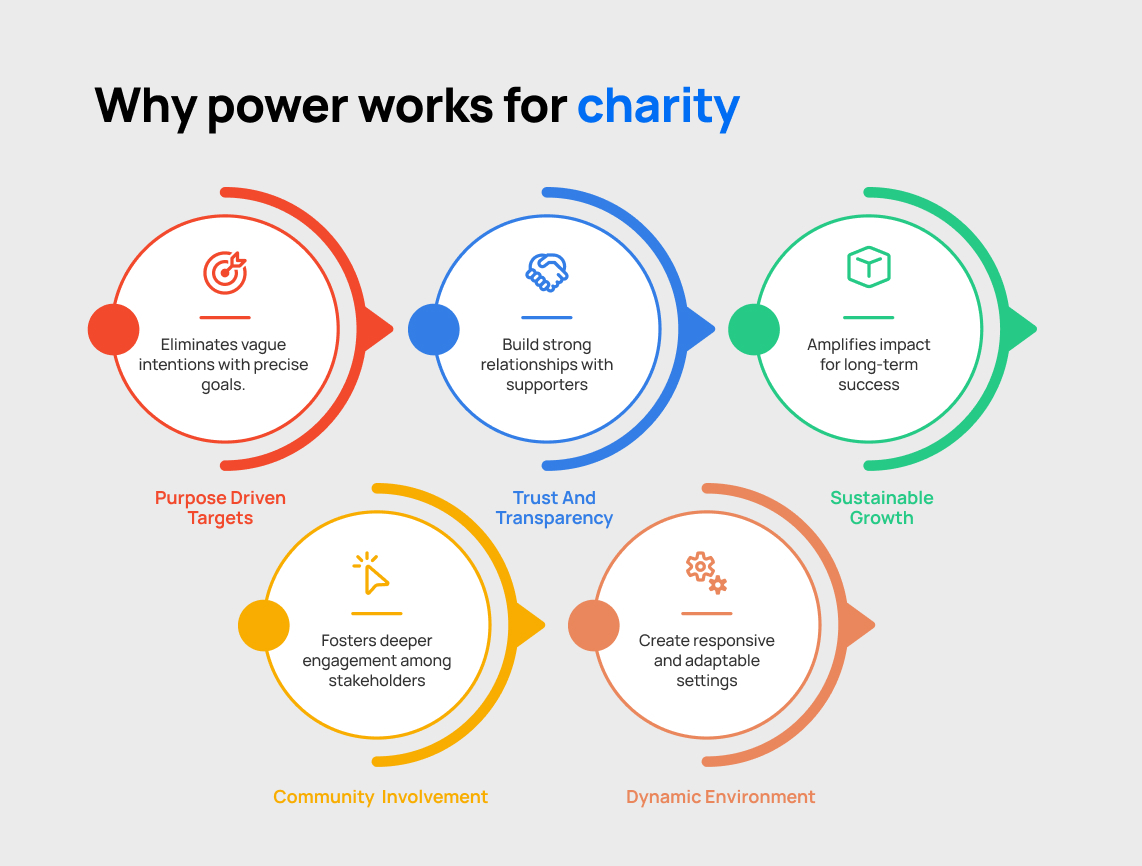
Why POWER Works for Charity
Using the POWER objective, guidelines and framework, solutions that were once high on the expectancy ladder can be turned into viable and mission-driven milestones.
Assign CRM Roles and Tasks to Your Team
Now that you have identified your supporting elements and set goals, it’s time to assess your resources- who will preside over CRM implementation? The appointed team should carry the required expertise, a fortified skillset, and must be associated from the stage of CRM onboarding. The team should be ready to pinpoint loopholes in the charity organisation’s workflow and identify the priority markers. They should be proactive to meet challenges head-on and come up with solutions.
For the efficient running of the CRM system, it is imperative to base it on a credible timeframe. With pre-defined goals, the implementation timeline should align well with your newfound strategy. Specifically, the timeline should be communicated to all the members and must get everyone on board with its launch.
Bringing a new system into an organisation is a tremendous shift, so you should always communicate before bringing it to its full potential. A collaborative approach with users, staff, volunteers, and donors is mandatory, as it will generate a sense of enthusiasm for the new beginnings. It will also define each individual’s role and responsibility with the CRM.
Charity organisations should involve all the members who will have an acquaintance with it to ensure their problem areas are communicated, acknowledged, and put to an immediate resolution with the help of the charity CRM. A winning CRM software should not be just technically sound, it should also be user-friendly.
List Must-Have Features for Your CRM
When all the early steps have been taken care of, the next follow-up is ensuring that the CRM lives up to its expectations, which is defining its capabilities to figure out how it will help in the hour of need. Charities are required to be extremely mindful of these nitty-gritties, like knowing how the CRM will function to attain maximum usability levels. Another approach to highlight the requirements is to make user stories.
User stories represent the responsibility of stakeholders to the CRM software and how well they acquaint themselves with it. For instance, “As a fundraiser, I need to see how often supporters donate so that I can send targeted email campaigns at the right time.”
This is called a functional requirement, which helps charities better understand their needs and how they are going to address them. With that simplistic approach, charities can operate better and do more good.
The sentence takes a peek into the preset goals you have for your organisation- notice any red flags, admin frustrations and suggest ways how CRM could be well implemented to improve your workflows. Charities can stack up all that information and create a user persona, which will give you a sense of accomplishment on how you will reach your final goals for a better fundraising campaign.
This strategy takes into account the justifications for why you need it, answering questions like whether it is needed or desired. Charities can keep track of these lists in a document like Microsoft Excel or Google Sheets. Charities are well-equipped to share user requirements across organisations, which will ensure clarity and involve the relevant parties, so that they can see for themselves how it is going and if there is any room for modifications. It can serve as a single source of truth, which will help the charity determine the best charity CRM for their needs.
Pick the Best CRM Provider for Your Business
Once charities have established their targets, team roles, and needs using the POWER methods, the next step is to research CRM providers. Aligning user requirements with existing systems becomes a significant factor, and the focus shifts to the core requirements, the budget, and the time constraints.
A CRM is a relationship – charities need to make sure their vendor understands the way they work and their goals. Good communication and good documentation are essential. Begin with a comparison of what you need to what is on the market and filter options by compatibility and potential for ROI.
Shortlist candidates and engage each one by passing over your requirements, and with a few detailed questions on capability. Beware of those who are reluctant to offer straight answers transparency is a must!
Examine costs beyond the initial price, such as setup, customisation, training, and long-term support. Hidden fees can eat into long-term value. Finally, the answers will also help you compare different charity vendors to make the right choice.
Careful vendor and cost analysis will ensure that charities can achieve a CRM system that will support their cause.
Conclusion- Why Sharp AI is the Best Choice for Charities
Let’s be honest—most CRMs weren’t made with charities in mind. They’re clunky, expensive, and leave you drowning in spreadsheets. Sharp AI is different. It’s like having an extra team member who actually gets your mission. Automate donor updates, track campaigns effortlessly, and say goodbye to tech frustrations—all without breaking the budget. The best part? You’ll wonder how you ever managed without it.
Curious? See for yourself and book a consultation: (Spoiler: Your future self will thank you.)