
All that scrolling must have left you tired, but come on; you still cannot find a beginner’s guide to a CRM system that solves all your problems. Sharp AI is aware of what you are searching for, a guide to CRM systems that allows you to check various aspects. From CRM trends in 2025 to CRM prices comparison, there’s plenty waiting for you in the store. Keep scrolling to read your favorite section!
What is a CRM System?
Beginning from the very beginning; CRM is an abbreviation for Customer Relationship Management. It’s like an ultra-intelligent notebook where you store all the details so that you can make every customer feel special without losing your mind remembering all this by heart.
Assume that you have a tiny lemonade business. Lots of people come and purchase your lemonade daily in the form of new individuals and friends. You would now wish to remember who prefers extra sugar, who prefers less ice, who owes you money, and who can return tomorrow.
In theory, you would be able to recall all that or write it down on post-its… and it would get tangled up in a mess which is why a CRM is your business best friend who keeps it all in order so you can sell more lemonade (whatever you sell) and make your customers happy.
Why Does a CRM System Matter?
AI-powered CRM software is significant as it transforms customer relationship management from reactive to proactive. Artificial intelligence in CRM enables companies to tap into the power of sophisticated analytics, predictive analytics, and automation, and thereby amplify their customer interactions. AI offers improved segmentation, personalization, and engagement with enhanced analysis of large quantities of data in real-time, and this assists companies in predicting customer needs and behaviors.
Types of CRM Systems
Following are some types of CRM systems and their activities:
Operational CRM System
- Automates and streamlines salesforce.
- Maps customer journey.
- Daily operations: Sales, Marketing, customer satisfaction.
Analytical CRM System
- Provides insights to customer data to understand customer behavior.
- Discovers trends.
- Enhances customer retention.
- Opens doors to more satisfying decision-making.
Collaborative CRM System
- Provides access to same data for all teams.
- Facilitates identification of goals, scalability, and budget.
Strategic CRM System
- Provides customer-centric approach to be utilized decisively.
- Increases data-based strategies to result in more satisfied customer retention and engagement.
- Best suited for companies interested in long-term customer relationships.
Campaign Management CRM System
- Practically utilized in sales-oriented sectors.
- Helps design and deliver market campaigns targeting specific groups.
- Facilitates multi-channel integrations such as email, social media, web ads, etc.
- Performance monitoring through metrics such as engagement, conversion rates, and ROI.
Cloud-Based CRM System
- Offers CRM capabilities using cloud technology which can be accessed everywhere.
- Enables remote access of employees, thus making taskforces more effective.
- Provides flexibility with regards to storage, users, and functionality.
- It integrates with other cloud-based applications and softwares.
- Perfect for organizations who are seeking a low-maintenance option for CRM.
Open-source CRM System
- Offers CRM capabilities with the option to customize and build based on business requirements.
- The users can change the CRM to suit business requirements.
- Generally, free to use but some of the customizations might be investment-driven.
- Suitable for firms that have technical capabilities to customize their CRM.
Mobile CRM System
- Ideal for mobile use, facilitating easier customer relations management by sales teams and customer service representatives on the field.
- Offers responsive web designs accessible to field agents through their smartphones or tablets.
- Real-time syncs and enables teams to instantly update customers’ information while communicating with them.
- Perfect for companies with staff who are in constant motion.
Key Features of a CRM System
-
Contact Management
Contact management in a CRM system entails the master repository for customer data, including personal details, history of interactions, buying habits, and demographics. Relational databases are used by CRM systems to store the contacts that enable firms to create one customer view (SCV). Data is usually indexed with high levels of performance to enable fast retrieval and update, usually optimized with full-text searching capabilities and real-time automatic synchronizing of data to ensure real-time consistency across touchpoints.
Through the customer data centralization, organizations can see their customers end-to-end. This does away with data silos, improves customer segmentation, and optimizes marketing campaign targeting models. It also optimizes operational efficiency through reduced manual data entry, as well as real-time notification of sales and support teams about consumer insights, improving response time as well as customer satisfaction.
-
AI Integration
AI-driven CRM platforms apply ML algorithms and NLP to facilitate and automate customer interactions. Predictive analysis and chatbots are incorporated into AI-driven CRM platforms in a bid to predict customer behavior, tag data automatically, and provide suggestions. AI-driven sentiment measurement is applied by CRM platforms to track customer satisfaction based on interaction and adaptive learning models that refine themselves with time based on history and engagement patterns.
AI-enabled CRM solutions enable businesses to predict sales behavior, optimize resource utilization, and optimize CLV. Lead scoring, suggestive communication, and follow-up automation improve management of the sales pipeline and ease customer care. AI also avoids human errors and ensures 24/7 customer interaction, which is really crucial for businesses with a global nature.
-
Sales Management
Sales management under CRM includes implementation of sales forecasting tools, opportunity management, and implementation of deal pipelines through dynamic workflows. User-configurable sales stages are implemented by CRM applications for simplicity of process to sales teams, while automation rules are implemented for reminder or alert for a follow-up. Advanced forecasting models of sales, implemented utilizing historical data, use statistical regression techniques for forecasting sales patterns and decision optimization. The apps complement CRM’s finance reporting and inventory management modules to track orders and predict revenues in real-time.
Due to effective sales management abilities, business organizations can optimize sales conversion rates through improved pipeline visibility and governance. Automation provides effective management of leads and opportunities, eliminating time spent on mundane tasks. Real-time forecasting improves resource planning in addition to enabling business organizations to offset market fluctuations effectively with adaptive sales strategies. Moreover, data-driven intelligence guides decisions, leading to optimized sales performance.
-
Engagement Tracking
Measurement of engagement in a CRM solution also includes the use of multi-channel communications monitoring like face-to-face, calls, email, and social media. Webhooks and third-party API integration with email marketing or social media capture event-driven data in advanced CRM solutions. The systems use activity-based analysis with customer activity like website visits, social actions, and email opens being monitored and stored within event logs. Engagement scores are calculated dynamically according to frequency of customer activity and recency of interaction.
-
Workflow Automation
Workflow automation engines are employed by CRM software in order to automate routine processes such as assigning leads, scheduling follow-up appointments, and entering data. By using condition-based triggers, CRM software can run automatically workflows, initiated by specific activities of the customers such as new lead creation, customer inquiry, or product purchase. All these automated workflows are driven by business rules engines and can be extended to third-party systems using RESTful APIs so that they can work seamlessly between tools.
Who is a CRM for?
A CRM system suits best:
- Sales Teams: In order to track the sales pipeline in real time so that no golden opportunity is ever missed.
- Customer Support Teams: Enables faster resolution of issues, building customized experience for customers.
- Marketing Teams: Use customer data for marketing campaigns and develop strategies based on real-time insights.
- E-commerce and other Businesses: In order to track customer journey and communicate with customers in real time.
Advantages of Utilizing a CRM System
-
AI-Powered Data Integration and Automation
AI-powered CRM software is fully integrated with your tools to provide a single platform for managing customer data across different channels. It automates lead scoring, predictive analysis, and personalized marketing, enhancing decision-making and improving customer experience. It reduces manual effort and enables businesses to scale quickly while sustaining quality services.
-
Centralized Customer Data Management
An integrated CRM integrates customer data into a single system with current access to records, interaction history, and purchase behaviors. This is a system that allows the sales, marketing, and customer service function to have the latest information, automate processes, and support communication.
- Proper Sales Pipeline Management
The total CRM software solution allows for premium-level management of the sales pipeline. Salespeople enjoy real-time deal visibility, which facilitates managing opportunities, identifying bottlenecks, and boosting conversion rates. The tasks and follow-through are handled by automation, leaving room for no lost leads and enabling rapid closing of deals.
-
Better Customer Satisfaction and Retention
An AI CRM system leverages analytics for segmentation of customers by behavior, one-to-one engagement and support, which strengthens relationships, foresees customer demand, and generates loyalty in the long term, building the maximum lifetime value.
-
Simple Reporting and Analytics
All-in-one CRM software features sophisticated reporting and analysis on sales, marketing, and customer satisfaction. With the power of AI, companies can design predictive reports, track KPIs, and make data-driven decisions on growth and optimization of resources.
When to implement a CRM?
To have an AI-Powered CRM Software is necessary if your company is experiencing growing complexity in customer interactions, sales pipelines, and data management. If your company is having a hard time centralizing customer information, pursuing follow-ups for leads, or automating routine tasks, a CRM offers a one-size-fits-all solution.
Furthermore, with the assistance of AI, it lends predictive analytics, lead scoring, and personalized communication at scale, and this will enable your sales and marketing teams to concentrate on high-value leads and customize customer journeys.
The best time to do that is prior to operational inefficiencies running out of control, preferably when your company is engaging with customers at multiple touch points and needs a systematic approach to increase engagement, streamline operations, and drive measurable growth.
How to Measure CRM Success in 5 Easy Steps?
Tracking your AI-powered CRM’s performance is critical for measuring its effectiveness on your business. Here are five easy steps to measure your CRM’s performance:
-
Gauge Customer Satisfaction
Utilize AI-driven CRM applications like sentiment analysis and auto-surveys to collect customer feedback in real-time. Customer sentiment reflects how satisfied customers are with your products, which has a direct impact on the success of CRM.
-
Monitor Sales Performance
An AI CRM considers sales metrics, which provide the user with insights into conversion rates and trends. It tracks revenue growth through key performance indicators such as closing of leads as well as deal size.
- Measure User Adoption and Engagement
Track how often your employees utilize the AI-enabled CRM. Usage frequency is the measure that the CRM is being properly deployed. Track usage, logins, feature adoption, and how much interaction the sales team is having on leads and contacts.
-
Data Quality Analysis
An AI-driven CRM increases data accuracy and completeness. High-quality data is derived from customer data, for example, contact and purchase history. Clean data supports better decision-making and CRM productivity.
-
ROI
Compute ROI based on the cost of CRM operation in relation to the advantages like raised sales, customer maintenance, and productivity. Compare the expense of CRM to the effect on revenue in key performance indicators like customer maintenance and sales growth.
The Most Significant CRM System Terms In 2025
-
Customer Engagement Center (CEC)
CECs combine case management, AI-based support, and omnichannel contact to deliver an end-to-end customer service experience.
-
360-Degree Customer View
A designation used for an integrated, aggregated view of every customer, combining information from all touchpoints to allow personal interactions and informed decision-making.
-
Lead Attribution
The process of finding out and assigning the marketing channels that are generating leads. This teaches companies what works best.
-
Funnel Velocity
A measure that tracks the velocity of leads traveling through the sales pipe, reflecting the effectiveness of the selling process and points of bottleneck.
-
Predictive Analytics
Using machine learning and AI to examine historical data to forecast future customer behavior, like buying habits or likelihood to churn, to respond in advance.
-
Sales Funnel Report
Visual depiction of the sales process, illustrating how leads move from one step to another, with scopes for improvement and maximizing conversion rates.
-
Automation
Employing technology to automatically execute routine tasks, such as sending reminder emails or updating customer records, making it more straightforward and effective.
-
Integration
Merger of CRM software with other software solutions (such as email marketing software or ERP solutions) in order to facilitate easy data transfer and a unified user experience.
-
Customer Journey Mapping
Mapping and visualizing the customer process, from awareness to purchase, so that companies can interpret and streamline the customer process.
-
AI-Powered Insights
By employing artificial intelligence in the analysis of customer information and generating actionable insights, like detecting patterns, predicting sales, or personalizing marketing efforts.
3 Easy Steps to Choose the Right CRM System
Choosing the right CRM system is essential to streamline your sales processes, enhance customer relationships, and improve business efficiency. With a vast array of options available, including AI-powered CRM software and all-in-one sales platforms, it can be challenging to make the right choice. Here are three easy steps to guide your decision:
-
Define Your Business Needs and Goals
Start by examining your company’s needs. Do you require an integrated CRM application that can run across platforms and provide end-to-end customer management, or do you require AI integration of CRM for performing automation and providing deeper insights based on data? Determine your purpose if you want to streamline sales pipeline management, automate customer support, or generate maximum leads.
-
Evaluate AI Capabilities and Automation
With AI-powered CRM software, you can use intelligent technology to streamline customer interactions, forecast sales patterns, and automate processes. Opt for CRM solutions with advanced AI capabilities like chatbots, predictive analytics, and automated follow-ups. Combining AI and CRM will enable your staff to emphasize high-value activities since the tool automates monotonous tasks with accuracy and velocity.
-
Opt for an All-in-One Solution for Scalability
In choosing a CRM, choose an all-in-one sales platform that integrates marketing, sales, and customer service functions into one system. This makes sharing easy, minimizes having to use several tools, and maximizes collaboration. An all-in-one CRM software will expand with your business, with features to customize and grow in scalability with changes in your needs.
Top 5 CRM Trends in 2025
-
Agentic AI: Autonomous AI-powered CRM Agents
Agentic AI is self-sufficient AI agents that can execute multi-step, complex tasks on different internal systems.
-
Generative AI for Content Generation
Generative AI is revolutionizing CRM solutions by making content-generation tasks such as email writing, generating meeting minutes, and internal note writing simple.
-
Predictive Analytics for Proactive Engagement
AI-based CRM systems use predictive analytics in order to predict buyer behavior, identify risks of churn, and offer next-best actions, which lead to increased customer satisfaction and loyalty.
-
AI-IoT Convergence for Greater Customer Insight
IoT and AI convergence is making it possible to have CRM systems with real-time behavior insights through intelligent devices.
-
Low-Code and No-Code AI CRM Platforms
The majority of AI-based CRM providers are offering low-code and no-code platforms by means of which users can create and configure AI-based workflows without prolonged programming knowledge.
Looking for more? Browse a few more of the CRM trends of 2025 here.
Top CRM Software Providers in 2025
-
SharpAI CRM
SharpAI CRM is a blend of CRM and AI. By using natural language processing and machine learning, it provides hyper-personalized customer experiences, automated elimination of routine work, and predictive intelligence. Its auto-qualification of leads through automation and AI-based sales forecasting enable SharpAI to empower high-value customers and prospects, and it is a must-have for future-oriented companies.
-
Salesforce Einstein
Salesforce Einstein is tightly integrated with Salesforce and provides AI-driven CRM software with lead scoring, lead automation, and real-time analytics support. Powered by its predictive analytics feature, organizations are capable of driving anticipatory insights into customers’ need and behavior, making it among the top AI-driven CRM software.
-
HubSpot CRM with AI Integration
HubSpot AI-based CRM functions in conjunction with its marketing toolset to offer an end-to-end all-in-one CRM. Through AI-based lead scoring and behavior tracking, it enables businesses to tailor approaches, automate follow-up calls, and derive actionable insights.

-
Zoho CRM Plus with Zia AI
Zoho CRM Plus also has Zia, the AI assistant of Zoho, to offer predictive sales recommendations, data-driven recommendations, and auto-business procedures. The capabilities of Zia also feature data sanitization as well as sentiment analysis.
-
Pipedrive with AI Automation
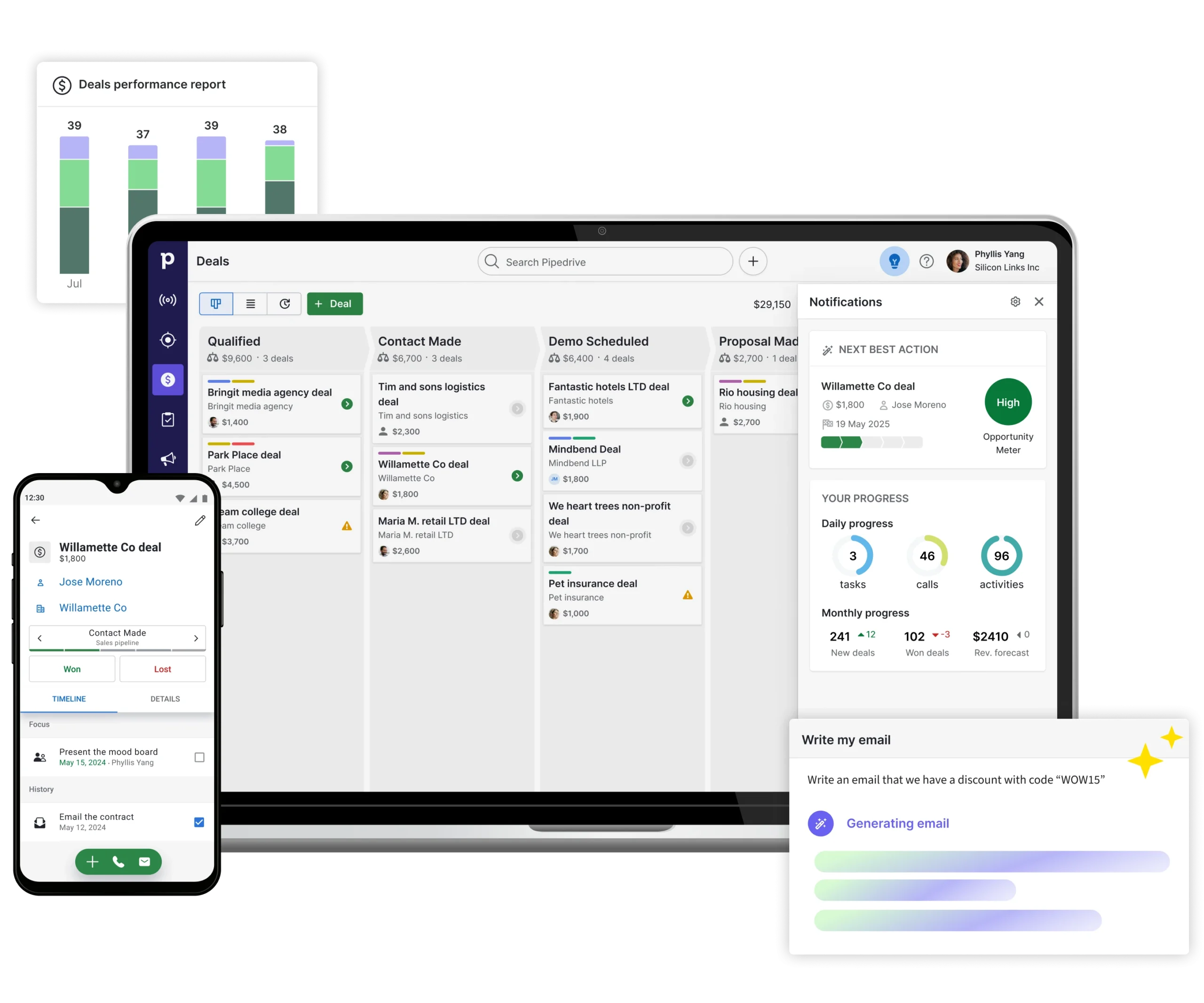
Pipedrive helps manage pipelines, forecasts sales, and automates lead nurturing using predictive analytics that enable the sales team to concentrate on priority leads.
-
Microsoft Dynamics 365 AI
Microsoft Dynamics 365 provides AI in CRM to facilitate one-to-one customer interaction, predictive sales performance prognostication, and smart marketing campaign optimization.
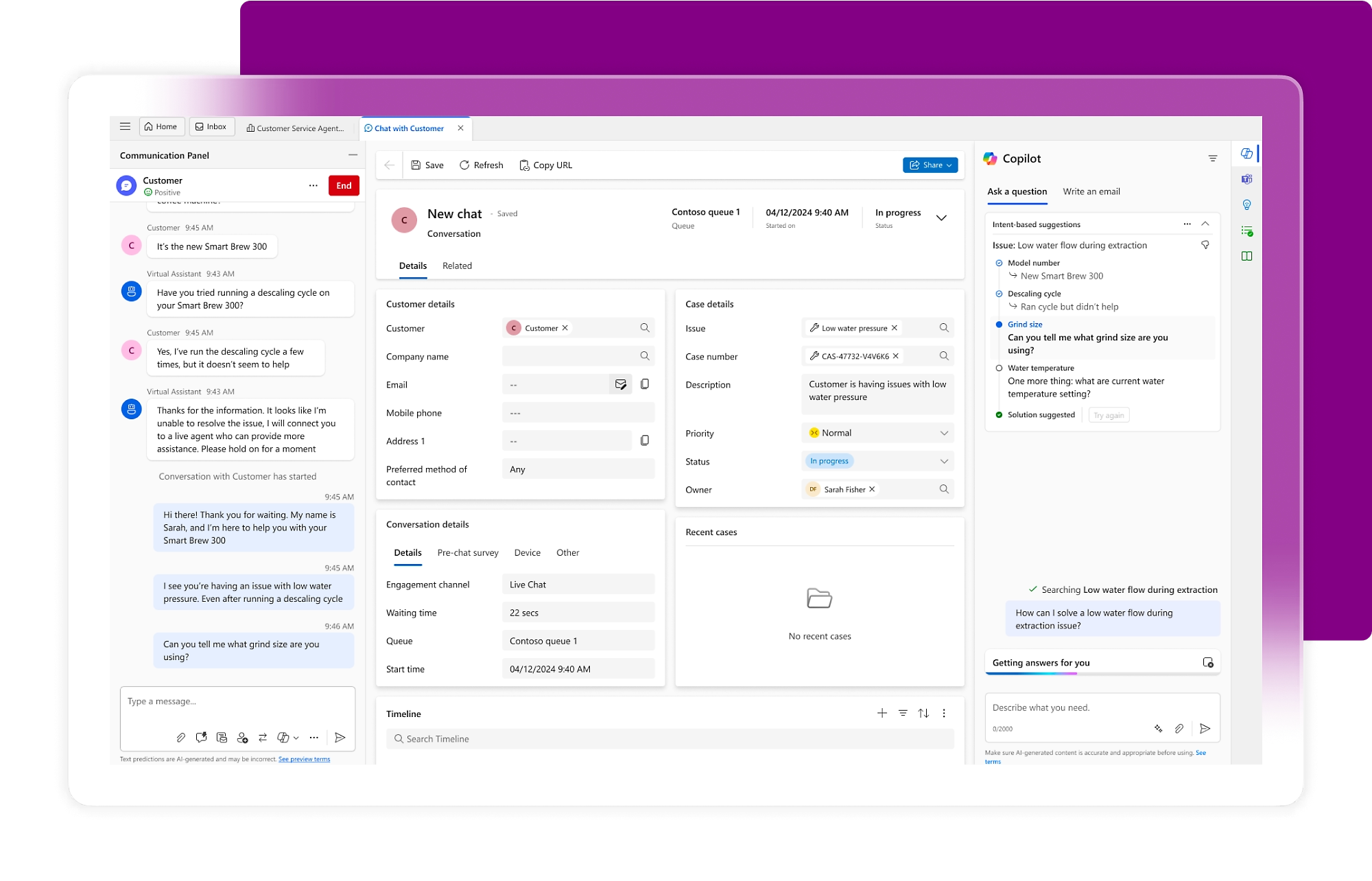
CRM Pricing: How Much Will a CRM Cost?
| CRM Platform | Starting Price (Per User/Month) | Free Tier Available |
| Sharp AI | £99 | ✅ |
| Salesforce | £240+ | ✅ |
| HubSpot | £96+ | ✅ |
| Pipedrive | £79+ | ❌ |
| Microsoft Dynamics 365 | £120+ | ❌ |
Why Choose Sharp AI?
Since there are various choices, you must be thinking; what CRM is best for my company? Before you get one, Take a look at the top 6 AI driven CRM tools.After that, you will realize how Sharp AI distinguishes itself from among the most promising alternatives. Why? Because its turbocharged, AI-driven CRM system combined with an array of solutions have an affordable price tag.
Why waste time and effort looking around and experimenting when you can save both and reserve a free demo today and get a hands-on feel of the top CRM software in UK.
Don’t let your competition poach your customers. Plan your growth now and increase sales by up to 60% with SharpAI CRM, make your company the benchmark. Don’t grow, dominate!
Interested in sales engagement and lead intelligence? Sharpai.app is your perfect match. Try it out for free today!